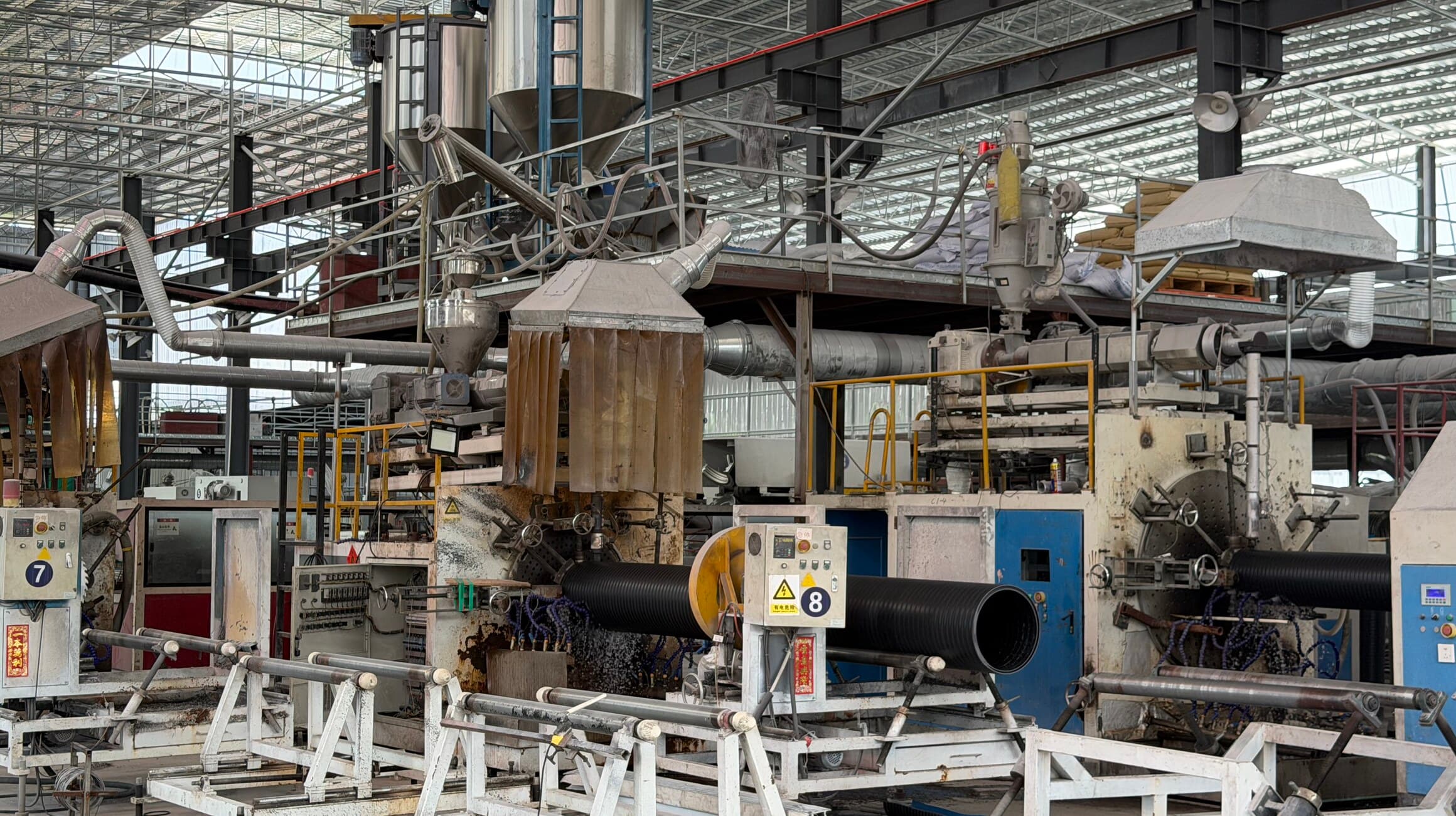
A pipe extrusion line is not complicated. Polyethylene granules go in one end, a continuous black tube comes out the other, and between them sit an extruder, a die, a calibration tank, a few cooling tanks, a haul-off and a saw. Any factory can buy that line. What a buyer is actually paying for is what happens at each station — the settings, the checks, and whether someone stops the line when a number drifts.
This article walks the line in order. At each step it says what the machine does, what can go wrong there, and what the result looks like when it reaches your site. The last section turns that into the four questions worth asking any supplier before a container is booked.
1. Compound: the pipe is decided before extrusion starts
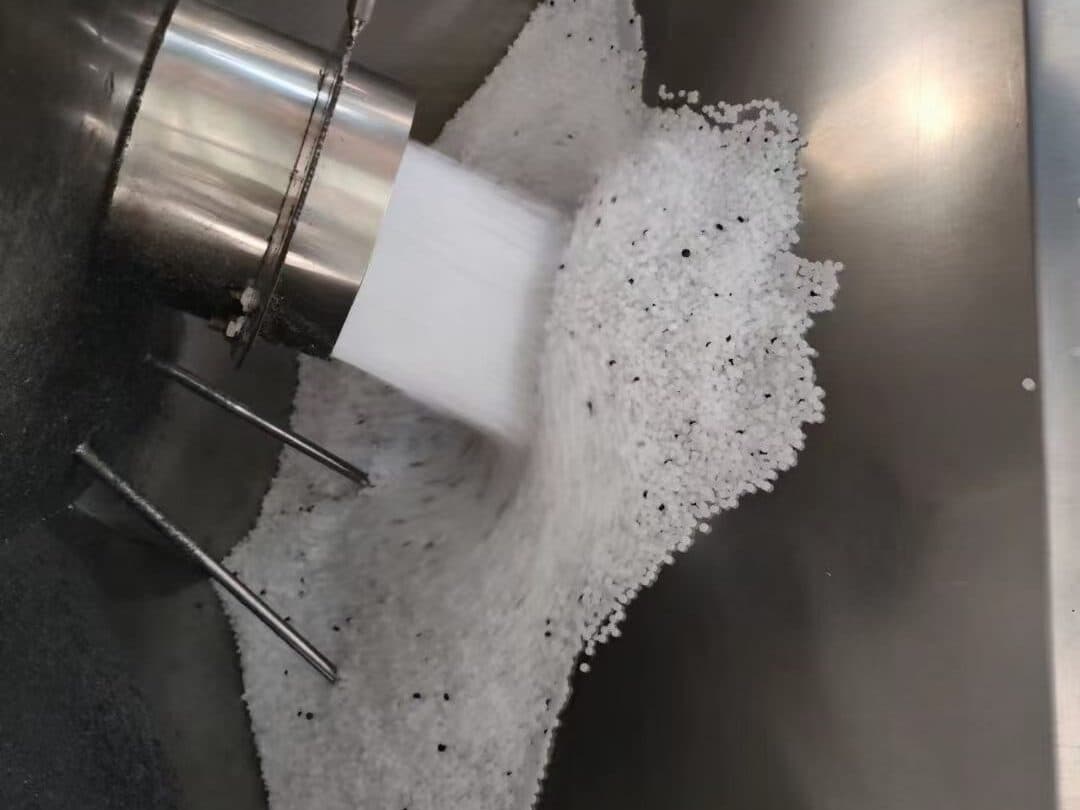
PE100 pipe is extruded from a pre-compounded resin: polyethylene with the carbon black, antioxidants and process stabilisers already blended in by the resin producer. The alternative — natural resin plus a black masterbatch dosed at the extruder — is cheaper and is where a great deal of substandard pipe begins. Masterbatch that is not fully dispersed leaves streaks of unprotected polymer that will chalk and crack in sunlight; a dosing unit that drifts leaves a batch with less than the 2 % carbon black that ISO 4427 requires.
2–3. Extruder and die: melting without degrading
A single-screw extruder melts the granules by a combination of barrel heat and the shear of the screw, then pushes the melt through a breaker plate into the die. Barrel zones run from about 180 °C at the feed to 210–230 °C at the head; the melt itself leaves the die at roughly 200–220 °C. Too cold and the melt is not homogeneous — you see it as unmelted specks or a matt, rough bore. Too hot, or too long in the barrel, and the antioxidant package is consumed before the pipe is even made, which shows up as a low OIT on the batch test and as brittle pipe years later.
The die forms the melt into a tube. Its spider legs — the struts that hold the mandrel — leave weld lines where the melt streams rejoin; a well-designed die and adequate melt pressure knit them so they are invisible and irrelevant. A worn or badly centred die produces wall that is thick on one side and thin on the other, which passes an average wall check and fails at the thin point under pressure.
4–5. Vacuum calibration and cooling: where the dimensions are fixed
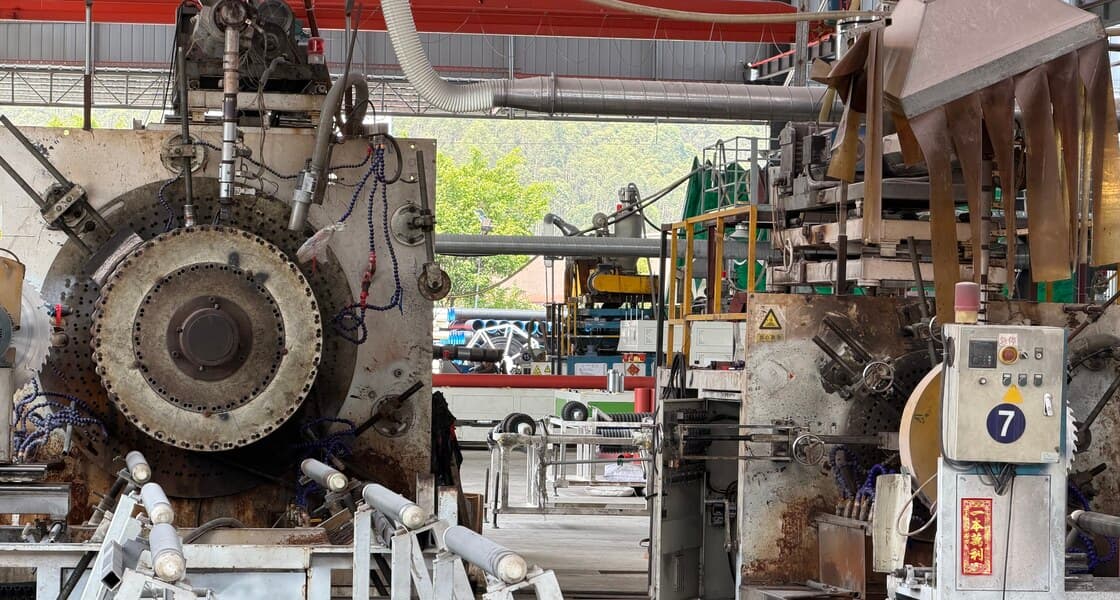
The hot tube leaves the die slightly larger than the finished size and is pulled through a water-cooled sleeve inside a vacuum tank. The vacuum draws the outer skin against the sleeve, fixing the outside diameter and freezing it in place; this is why a PE pipe's outside diameter is so consistent and why the standards specify OD rather than bore. The wall thickness, by contrast, is not set by any tool. It is the ratio of extruder output to haul-off speed: pull faster for the same output and the wall thins.
- 1
Vacuum tank
Sets the outside diameter and ovality. A tank at the wrong vacuum gives an out-of-round pipe; a sleeve that is scored leaves a longitudinal line on every metre.
- 2
Spray cooling tanks
Two to five tanks in series, depending on wall thickness, bring the pipe from a molten core to something a saw can cut. Thick-wall pipe cools from the outside in, so the bore is still soft long after the surface is hard.
- 3
Cooling length as a limit
The line speed for a given wall is limited by cooling, not by the extruder. A DN630 SDR 11 pipe with a 57 mm wall runs at a fraction of a metre per minute; a supplier quoting output rates that ignore this is quoting for thin wall.
6–8. Haul-off, marking and cutting
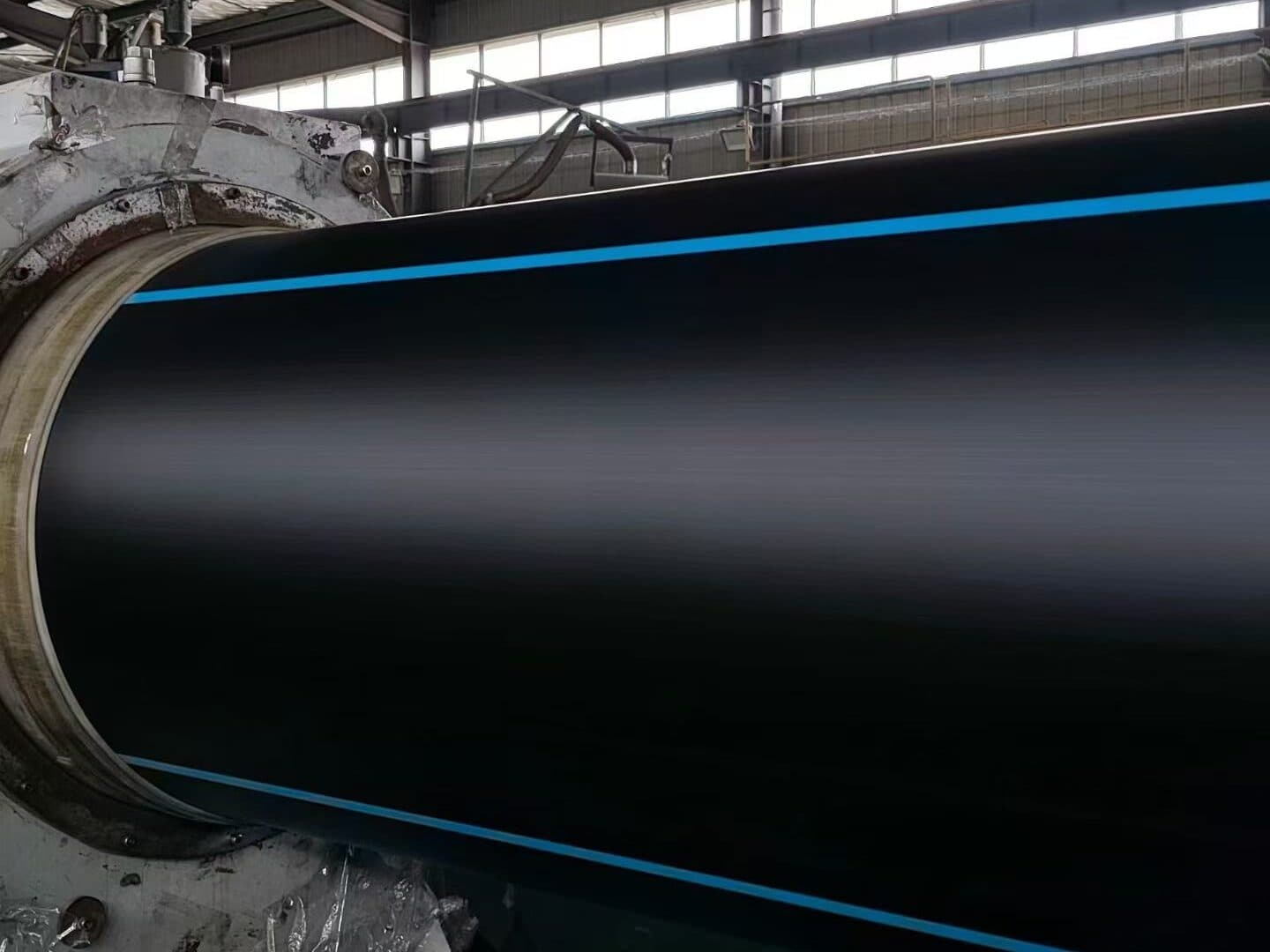
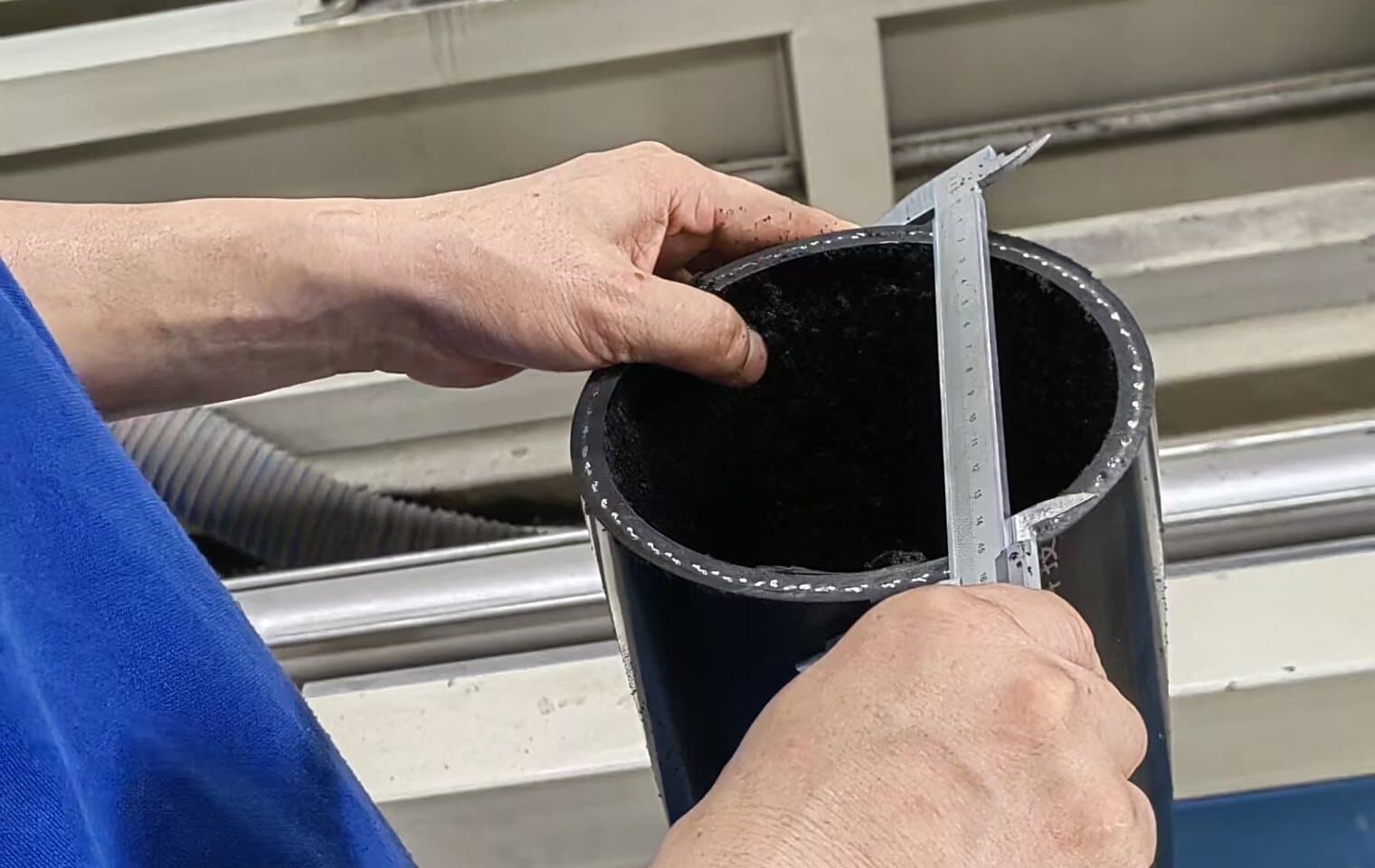
The haul-off is a set of caterpillar tracks that grip the pipe and pull it through the line at a precisely controlled speed. Its speed against extruder output is the wall-thickness control loop; modern lines measure wall with ultrasonic gauges just after the calibrator and adjust the haul-off automatically. Ask whether the line has that gauge. A line without one relies on an operator with a caliper checking cut ends, which catches drift only after a length of pipe has been produced with the wrong wall.
Marking comes next. ISO 4427-2 requires, at intervals of no more than one metre, the standard number, nominal size and SDR, material grade, pressure class, manufacturer and a production code that traces to the batch. The marking is the pipe's identity — a pipe that reaches site without it cannot be tied to a test certificate, and an inspector is right to reject it.
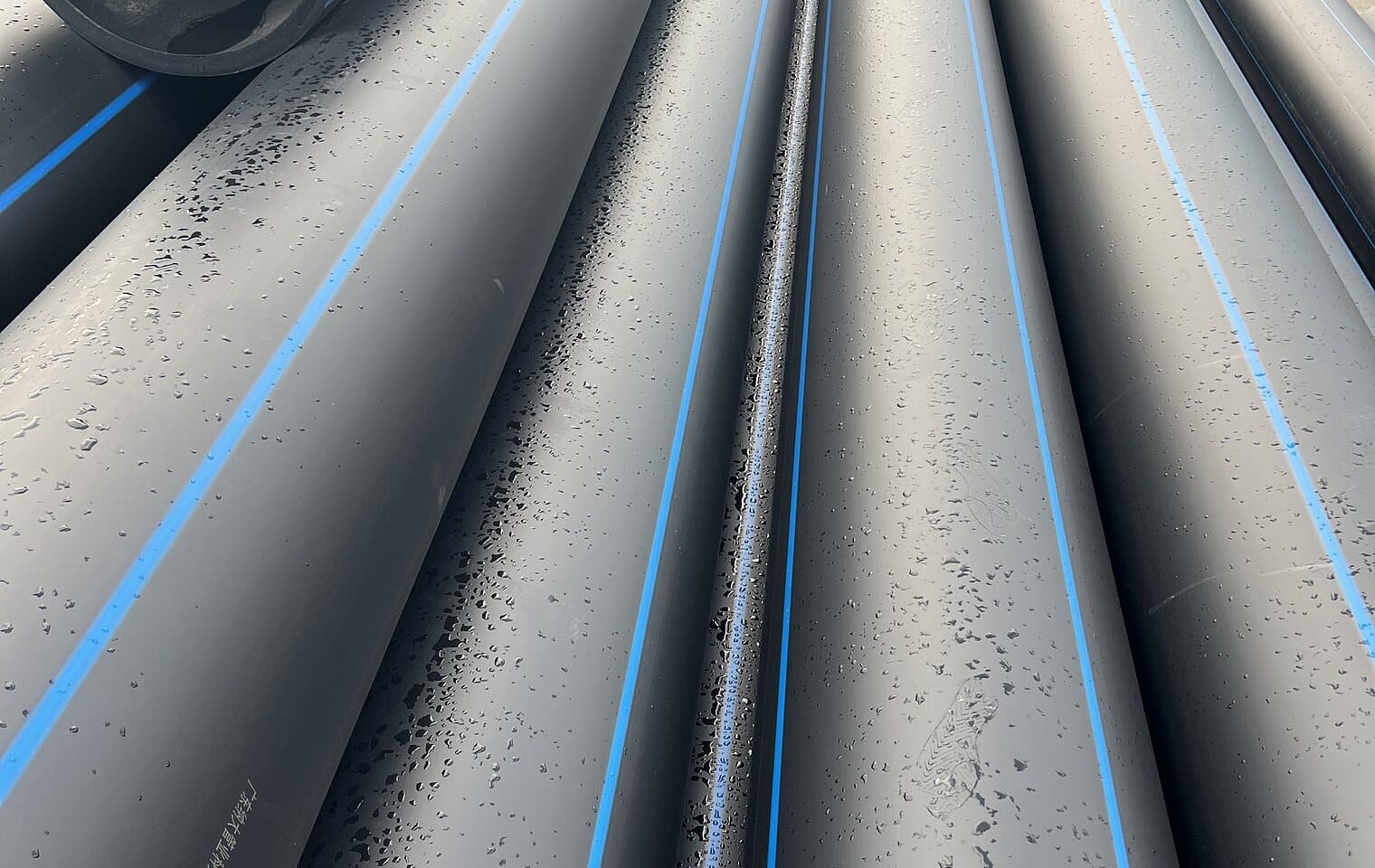
The saw cuts straight lengths — 6 m, 11.8 m or 12 m to suit the container — square to the axis, which matters because a butt-fusion machine faces the ends but a badly cut end wastes pipe. Small sizes bypass the saw and go to a coiler, where the pipe is wound while still slightly warm so it takes the coil without kinking.
9. Batch tests: the part that separates factories
Everything up to this point produces a pipe that looks right. The batch tests are what prove it is right, and they are where a low-cost factory saves its money: the tests take hours to days, tie up a laboratory and occasionally fail a batch that has already been made. A factory that does them holds the batch until results clear. One that does not ships on appearance.
| Test | Method | Requirement | What a failure means |
|---|---|---|---|
| Dimensions and ovality | ISO 3126 | OD and wall within ISO 4427-2 Table 2 tolerances | Haul-off drift or a worn calibrator |
| Melt mass-flow rate | ISO 1133, 190 °C / 5 kg | Within ±20 % of the compound's MFR | Polymer degraded in the barrel |
| Oxidation induction time | ISO 11357-6, 200 °C | ≥ 20 min | Stabilisers consumed by over-heating or poor compound |
| Carbon black content | ISO 6964 | 2.0–2.5 % by mass | Under-dosed masterbatch; no UV protection |
| Longitudinal reversion | ISO 2505, 110 °C | ≤ 3 % | Cooled too fast; locked-in stress |
| Hydrostatic strength, 20 °C | ISO 1167, 12.0 MPa hoop | No failure in 100 h | Wrong material grade or a wall defect |
| Hydrostatic strength, 80 °C | ISO 1167, 5.4 MPa / 5.0 MPa | No failure in 165 h / 1 000 h | Slow crack growth resistance below PE100 |
What to ask before you order
- Is the pipe extruded from pre-compounded PE100, or from natural resin plus masterbatch? Ask for the compound producer and grade name.
- Does the line have an inline ultrasonic wall gauge, or is wall checked by hand at the saw?
- Which of the batch tests in the table above are run on every batch, and which only on request? Ask for a recent certificate with batch numbers.
- Is the batch held until the 165-hour test clears, or shipped on dimensions and appearance?
None of those questions is unusual and a serious factory will answer all four in an afternoon. The answers say more about what will arrive in the container than any brochure does.
Sources and standards
- ISO 4427-2: Polyethylene pipes for water supply — Pipes
- ISO 1167: Thermoplastics pipes — Determination of resistance to internal pressure
- ISO 2505: Thermoplastics pipes — Longitudinal reversion
- Plastics Pipe Institute — Handbook of Polyethylene Pipe, chapter 5 (manufacturing)
- PE100+ Association — quality material list and technical guidance