HDPE pipe specifications are short on words and long on abbreviations. Most disputes we see between buyers and suppliers come down to two people reading the same abbreviation differently — SDR confused with S series, PN read as working pressure, MRS mistaken for a test pressure. This page defines the terms as the standards define them, with the standard named so you can check.
Terms are listed in the order you meet them: material, then geometry, then pressure, then jointing, then the tests on a certificate. Each entry has its own anchor, so you can link to a single definition from a tender clarification.
Key features
- Material grades: PE80, PE100, PE100-RC and what MRS actually measures
- Geometry: DN, OD, SDR, S series, wall tolerance and ovality
- Pressure: PN, design coefficient, temperature derating and surge
- Jointing: butt fusion, electrofusion, stub ends and the fusion bead
- Certificate tests: OIT, MFR, carbon black, hydrostatic and slow crack growth
Glossary
- HDPE
- High-density polyethylene: polyethylene with a density of about 0.94–0.96 g/cm³. In pipe, the term is used loosely for any PE80 or PE100 pressure pipe; the material grade, not the word HDPE, is what the standard classifies.
- PE100
- A polyethylene compound whose 50-year hydrostatic strength at 20 °C (MRS) is at least 10 MPa. It is the standard material for water and gas pressure pipe under ISO 4427, EN 12201 and GB/T 13663.
- PE80
- A compound with an MRS of 8 MPa. Same dimensions as PE100 pipe, one pressure class lower for the same SDR — SDR 11 gives PN12.5 in PE80 and PN16 in PE100.
- PE100-RC
- PE100 with certified resistance to slow crack growth, typically shown by a notch test exceeding 8,760 hours and a point-load test. Specified for trenchless installation and sand-free bedding, where the pipe wall is scored by stones or during pulling.
- MRS
- Minimum Required Strength: the lower confidence limit of the hoop stress the material sustains for 50 years at 20 °C, rounded down to the nearest step of the R10 series. MRS 10 MPa = PE100. It is a material property, not a test pressure.
- Design coefficient (C)
- The safety factor applied to MRS to obtain the design stress: σs = MRS ÷ C. ISO 4427 uses a minimum of 1.25 for water; some national rules and gas standards use higher values, which lower the PN for the same SDR.
- SDR
- Standard Dimension Ratio: nominal outside diameter divided by minimum wall thickness. A lower SDR means a thicker wall and a higher pressure class. ASTM calls the same ratio DR.
- S series
- Pipe series number, S = (SDR − 1) ÷ 2. SDR 11 is S 5; SDR 17 is S 8. Some European tenders quote S instead of SDR; they describe the same pipe.
- PN
- Nominal pressure in bar: the allowable working pressure for water at 20 °C over 50 years, PN = 20 × σs ÷ (SDR − 1) with σs in MPa. It is not a test pressure and not valid above 20 °C without derating.
- DN / OD
- In ISO and EN standards DN is the nominal outside diameter in millimetres — DN110 pipe is 110 mm outside. In ASTM and AWWA, sizes are IPS or DIPS inches whose actual OD differs from the nominal, so 4 in IPS is 114.3 mm.
- Inside diameter
- DN minus twice the wall thickness. It is what hydraulic calculations need and it changes with SDR: DN110 has an inside diameter of about 96 mm at SDR 17 and 90 mm at SDR 11.
- Wall thickness (emin / emax)
- emin is the minimum wall the standard tabulates for a size and SDR. emax adds the manufacturing tolerance — for ISO 4427 grade V, 0.1 × emin + 0.1 mm rounded up. Production wall must fall between the two at every point.
- Ovality
- Out-of-roundness: the difference between the largest and smallest outside diameter in one cross-section, limited by ISO 11922-1. Coiled pipe re-rounds after unrolling; ovality is measured before jointing because electrofusion couplers need a round pipe.
- SN (ring stiffness)
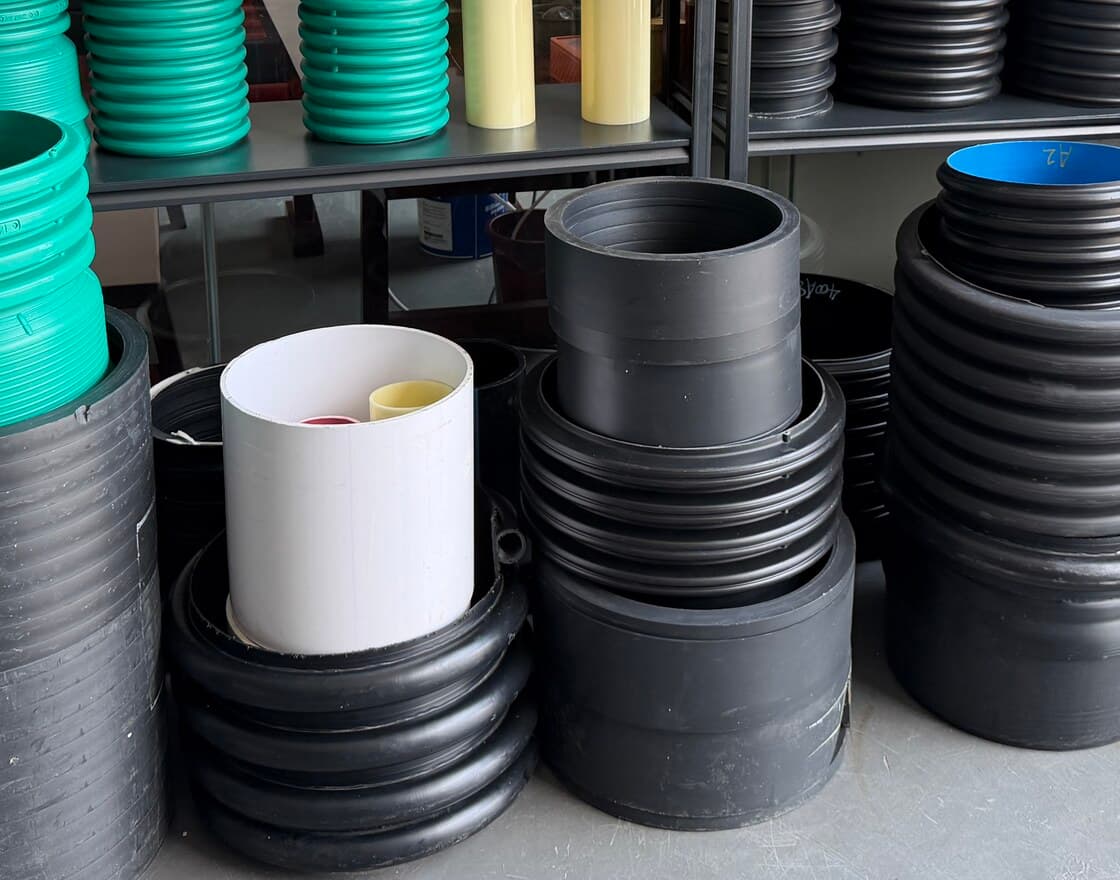
- Nominal ring stiffness in kN/m², measured to ISO 9969. It classifies non-pressure pipe — corrugated and structured-wall drain and sewer — by resistance to deflection under soil load. SN4 and SN8 are the common buried classes.
- Butt fusion
- Joining two pipe ends by heating both faces on a heated plate and pressing them together, forming a double bead. Used from about DN63 upward; parameters per ISO 21307 or DVS 2207-1. The joint is as strong as the pipe when the pipes have the same SDR.
- Electrofusion
- Joining with a coupler that contains an embedded heating wire. Pipe ends are scraped, cleaned and clamped, then the coupler is energised. Used for small sizes, repairs and tie-ins where a butt fusion machine cannot go; it forgives more misalignment but requires scraping without exception.
- Stub end and backing flange
- The HDPE-to-metal transition: a short PE stub end with a flared face is butt-fused to the pipe, and a loose steel backing flange behind the flare bolts to the valve or steel flange. Also called a flange adapter.
- Fusion bead
- The rolled-over ring of material formed on both sides of a butt fusion joint. Its shape is the first quality check: uniform, rolled back to the pipe surface, no notch at the centre. It can be removed and bent to inspect the joint.
- OIT
- Oxidation Induction Time: the minutes a sample resists oxidation at 200 °C in oxygen, measured to ISO 11357-6. ISO 4427 requires at least 20 minutes. It checks that the antioxidant package survived extrusion.
- MFR
- Melt mass-Flow Rate at 190 °C under a 5 kg load, in g/10 min. The pipe's MFR must stay within ±20 % of the compound's declared value; a larger shift means the polymer degraded in processing.
- Carbon black content
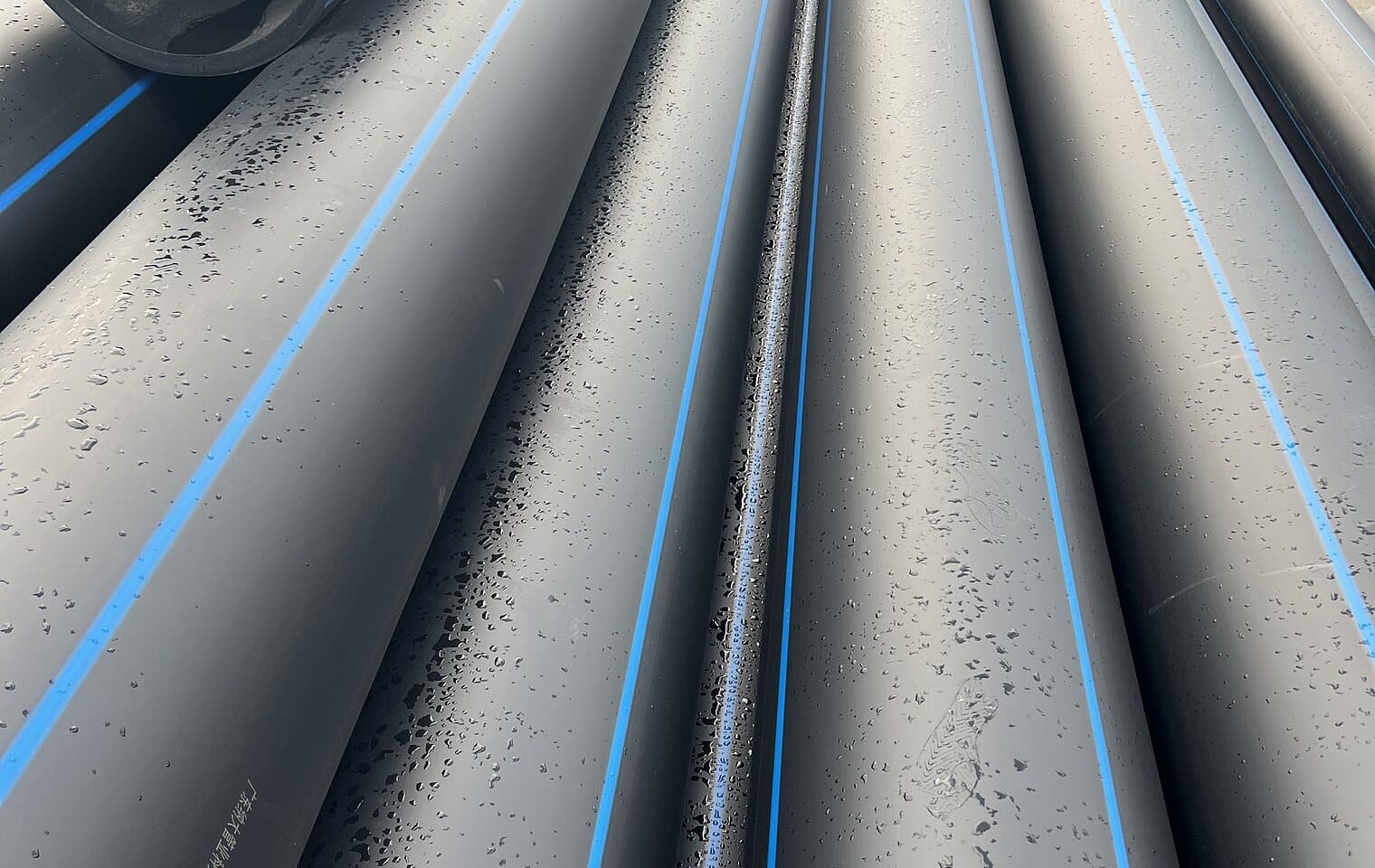
- Black PE pipe carries 2–2.5 % well-dispersed carbon black (ISO 6964) for UV protection, which is what allows outdoor storage. Blue or coloured pipe relies on other stabilisers and has a shorter outdoor storage life.
- Hydrostatic strength test
- Pressurising pipe samples in a water bath to ISO 1167. For PE100, ISO 4427 requires 100 hours at 20 °C and 12.0 MPa hoop stress, 165 hours at 80 °C and 5.4 MPa, and 1,000 hours at 80 °C and 5.0 MPa without failure.
- Temperature derating
- Reducing the allowable pressure when the water is warmer than 20 °C. Typical factors from ISO 13761 are about 0.87 at 30 °C and 0.74 at 40 °C — a PN16 pipe carries about 11.8 bar at 40 °C. Derating reduces the allowable pressure; it does not change the product.
- Slow crack growth (SCG)
- The failure mode of PE pipe under long-term stress at a scratch or stone: a crack that grows slowly through the wall. Measured by the notch pipe test (ISO 13479) and, for PE100-RC, the point-load and FNCT tests.
- Surge (water hammer)
- Short pressure spikes from valve closure or pump stop. PE tolerates them well because of its low modulus; AWWA C906 allows occasional surges to 2.0 × and recurring surges to 1.5 × the pressure class without derating the pipe.
- Coil and straight length
- Small sizes, typically to DN110, are supplied in coils of 50–100 m; larger pipe comes in 6 m, 11.8 m or 12 m straight lengths. Coils reduce joints and freight volume but need re-rounding before electrofusion.