
The literature on this question is unusually partisan. The most thorough comparisons of ductile iron against plastics are published by the ductile iron industry's own research association; the most thorough rebuttals are published by plastics associations. Both sets of numbers are defensible and both are selected.
We are not neutral either. What follows tries to be useful anyway, by being specific about the conditions under which each answer changes.
Two arguments against HDPE that are correct
Neither argument disqualifies polyethylene. Both change the answer in a defined set of projects, and a supplier who will not say so is not worth listening to on the rest.
Where HDPE genuinely wins
- Leakage. Fused joints have no gasket to relax and no bell to pull. In distribution networks the joint is where water is lost, and removing the joint removes the loss.
- Ground movement. PE bends. In seismic zones, in mining subsidence, in soft alluvium, a pipeline that can deform without cracking survives events that fracture rigid materials.
- Corrosive ground and corrosive water. No cathodic protection, no lining, no coating to damage during handling. This is the argument that decides most coastal and industrial schemes.
- Trenchless installation. Long fused strings can be pulled through a bore or inside a failing pipe. Rigid materials in short sticks with joints cannot do this without a very different method.
- Handling. A length of PE can be moved by two people where the equivalent iron needs a crane. On a remote site with no lifting plant, that is not a convenience, it is feasibility.
Side by side
| Criterion | HDPE (PE100) | Ductile iron | PVC-U / PVC-O |
|---|---|---|---|
| Joint type | Fused, monolithic | Gasketed bell and spigot | Gasketed or solvent |
| Leakage at joints | None by design | Gasket dependent | Gasket dependent |
| Corrosion | Immune | Needs lining and often protection | Immune |
| Bore for a given nominal size | Smaller | Largest | Between the two |
| Tensile strength | Lowest | Highest | Middle |
| Ground movement | Excellent | Poor to fair | Poor |
| Trenchless install | Excellent | Limited | Limited |
| Weight to handle | Lightest | Heaviest | Light |
| Surge tolerance | High | Moderate | Low — brittle above rating |
| Repair on site | Fusion, needs power | Mechanical coupling | Mechanical coupling |
| Design life | 50+ years | 50+ years | 50+ years |
Cost, honestly
Published lifecycle comparisons put HDPE 40–45% below ductile iron over fifty years, and they are produced by parties with an interest. Comparisons from the iron side show iron ahead once pumping energy is counted. Both are right about their own model, and the models differ in whether pumping energy is included and how leakage is valued.
- 1
Materials cost is the least useful number
It is the one most often compared and the smallest share of a completed main. Installation, jointing labour, excavation width and lifting plant usually dominate.
- 2
Pumping energy favours the largest bore
On a gravity scheme it is irrelevant. On a scheme pumping continuously it can exceed the entire capital difference over fifty years, and it favours ductile iron.
- 3
Leakage favours the fused system
A distribution network losing a fifth of its input — common in older systems — loses it at joints and connections. This is the number that moves most in HDPE's favour, and it is the one iron-side models tend to leave out.
- 4
Do the calculation for your scheme
Pumped or gravity, leak rate, energy tariff, ground conditions. The answer flips on those four inputs, which is precisely why the published conclusions disagree.
A short decision rule
| Project character | First choice | Reasoning |
|---|---|---|
| Distribution network, leak reduction is the goal | HDPE | Fused joints remove the loss mechanism |
| Long pumped transmission, energy dominates | Ductile iron | Larger bore for the nominal size |
| Seismic or subsiding ground | HDPE | Deforms instead of fracturing |
| Aggressive soil or saline groundwater | HDPE or PVC | No corrosion path |
| Trenchless renewal of a failing main | HDPE | Only system that pulls in as a continuous string |
| Exposed or above-ground with point loads | Ductile iron | Tensile margin |
| Low-pressure gravity sewer, cost-driven | PVC or structured wall PE | Ring stiffness, not pressure class, is the design basis |
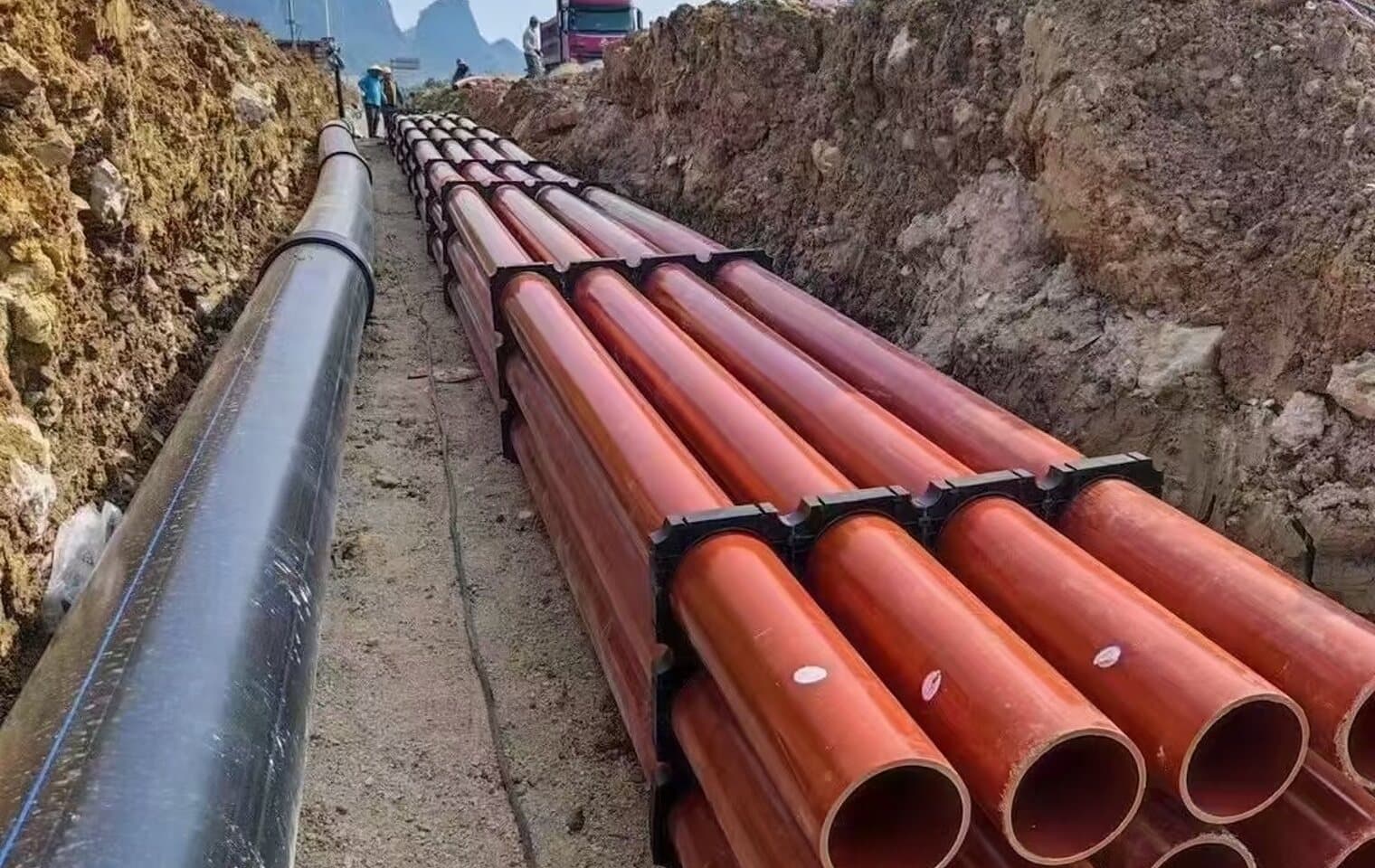
Questions to put to any supplier, including us
- Which pumping assumption is in your lifecycle model, and what happens to the answer if I change it?
- What leak rate did you assume for the jointed alternative, and where does that figure come from?
- Is the design life claim yours or the standard's?
- What is the bore, not the nominal size, at the class you are quoting?
- Who tested the resin lot in this order, and can I see the certificate?