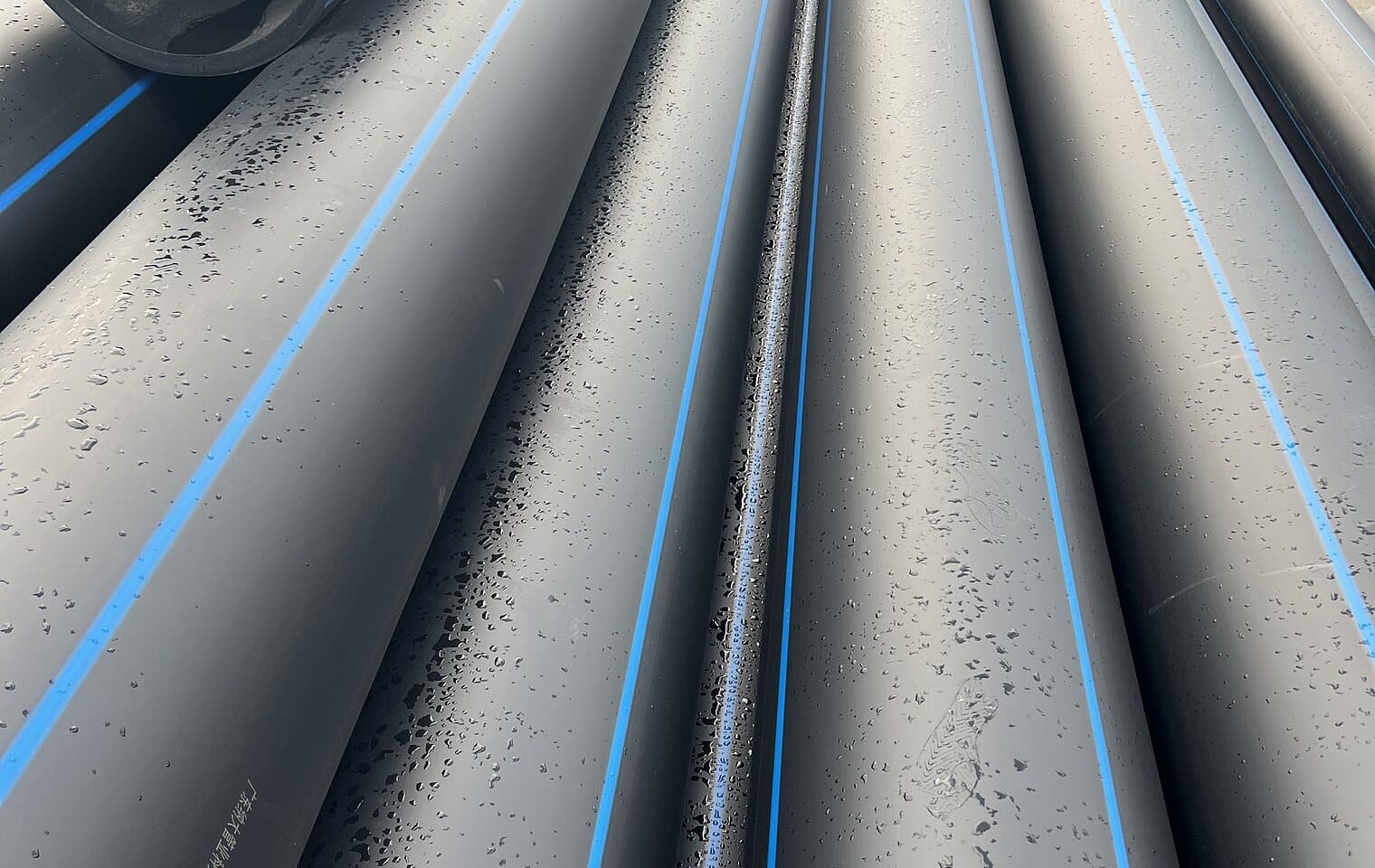
Every polyethylene pressure pipe you will ever buy is described by three numbers: the outside diameter, the wall thickness, and the material grade. SDR collapses the first two into one ratio, and that ratio — not the diameter — is what sets the pressure the pipe can hold.
This is the part that surprises buyers most often: a DN110 SDR 11 pipe and a DN630 SDR 11 pipe carry exactly the same pressure. The big one has a far thicker wall, but proportionally the same wall, and pressure rating follows the proportion.
What SDR actually is
SDR = OD ÷ wall thickness
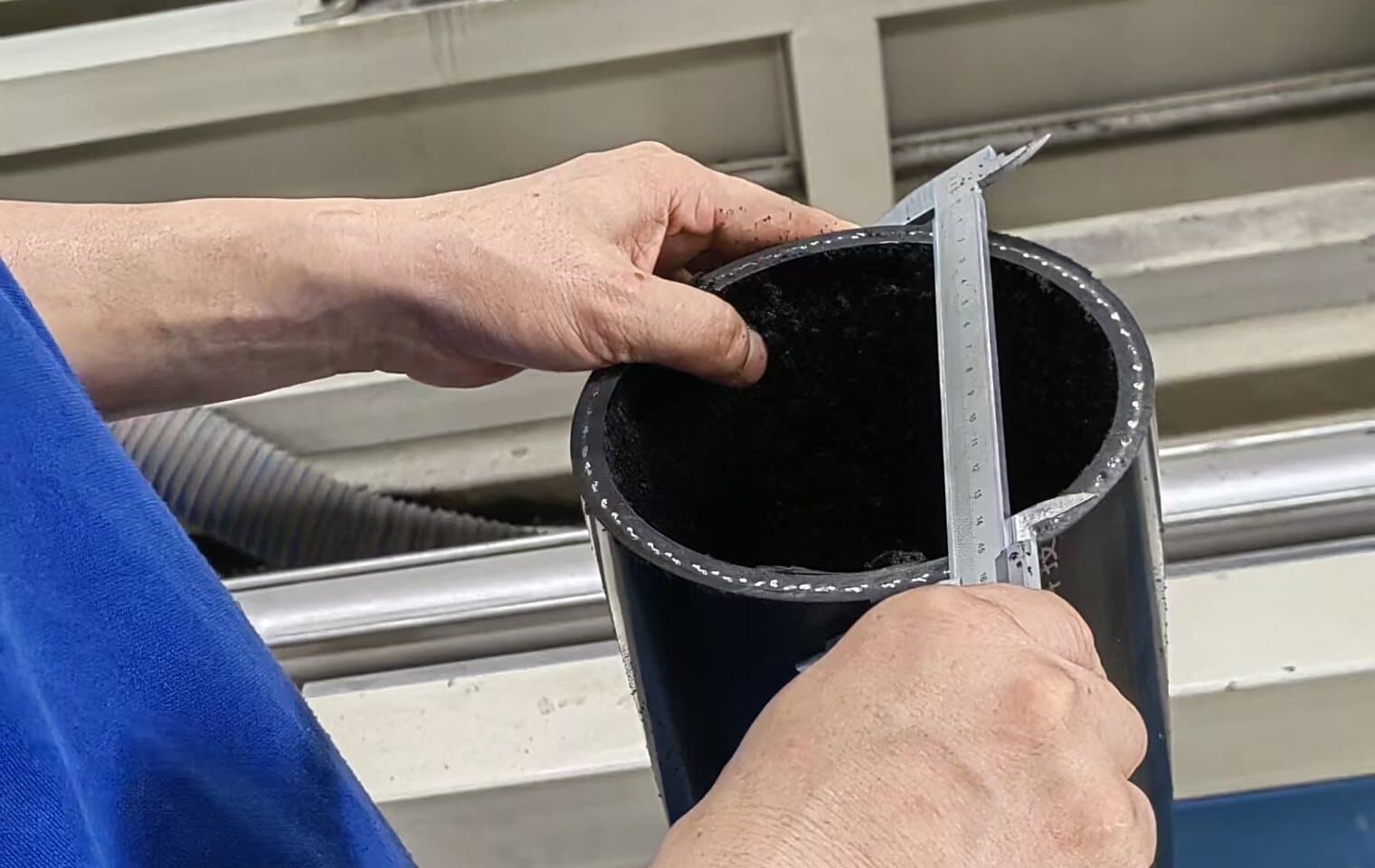
OD is the outside diameter in millimetres, wall thickness is the minimum wall in millimetres. Both are measured, not nominal.
A lower SDR means a thicker wall relative to the bore, and therefore a higher pressure class. SDR 7 is a heavy-wall mining pipe; SDR 41 is a thin-wall gravity or low-head pipe. The number runs backwards to the intuition that bigger is stronger, which is the single most common source of specification errors we see.
The metric route: ISO 4427 and EN 12201
Outside North America, pressure class is expressed as PN — the nominal pressure in bar that the pipe will hold with water at 20 °C for 50 years. It comes from the minimum required strength of the resin and a design coefficient.
PN = (20 × MRS) ÷ (C × (SDR − 1))
MRS is the minimum required strength in MPa — 10.0 for PE100, 8.0 for PE80. C is the design coefficient, 1.25 for water under ISO 4427.
Put PE100 and C = 1.25 into that and the whole PN table falls out of a single division. This is why a PE100 SDR 11 pipe is PN 16 everywhere in the ISO world, in every diameter, from every manufacturer.
| SDR | Pressure class | Nominal pressure | Typical use |
|---|---|---|---|
| SDR 7.4 | PN 25 | 25 bar | Mining slurry, high-head pumping |
| SDR 9 | PN 20 | 20 bar | Pumped mains, industrial process |
| SDR 11 | PN 16 | 16 bar | The default for potable distribution |
| SDR 13.6 | PN 12.5 | 12.5 bar | Distribution where head allows |
| SDR 17 | PN 10 | 10 bar | Trunk mains, gravity-fed schemes |
| SDR 21 | PN 8 | 8 bar | Irrigation, low-head transfer |
| SDR 26 | PN 6 | 6 bar | Drainage under pressure, land drainage |
| SDR 33 | PN 5 | 5 bar | Very low head, sleeving |
| SDR 41 | PN 4 | 4 bar | Gravity, ducting, protection |
The imperial route: ASTM and PE4710
North American practice starts from the same physics and arrives at psi through a different vocabulary. The resin is PE4710 rather than PE100, strength is expressed as a hydrostatic design basis in psi, and the design factor is applied differently.
PR = (2 × HDS) ÷ (DR − 1)
HDS is the hydrostatic design stress in psi — 1,000 psi for PE4710 water service at 73.4 °F, derived from an HDB of 1,600 psi with a 0.63 design factor.
| DR | Pressure rating | Nearest metric class | Difference |
|---|---|---|---|
| DR 7.3 | 333 psi | PN 25 (363 psi) | Metric class is higher |
| DR 9 | 250 psi | PN 20 (290 psi) | Metric class is higher |
| DR 11 | 200 psi | PN 16 (232 psi) | Metric class is higher |
| DR 13.5 | 160 psi | PN 12.5 (181 psi) | Metric class is higher |
| DR 17 | 125 psi | PN 10 (145 psi) | Metric class is higher |
| DR 21 | 100 psi | PN 8 (116 psi) | Metric class is higher |
| DR 26 | 80 psi | PN 6 (87 psi) | Metric class is higher |
Temperature: the derating nobody applies until it is too late
Both tables assume water at ambient temperature. Polyethylene loses strength as it warms, and the loss is not small. A pipe carrying process water at 40 °C holds roughly three-quarters of its rated pressure; at 60 °C it holds about half.
| Operating temperature | Factor | SDR 11 (PN 16) becomes | SDR 17 (PN 10) becomes |
|---|---|---|---|
| 20 °C | 1.00 | 16 bar | 10 bar |
| 30 °C | 0.87 | 13.9 bar | 8.7 bar |
| 40 °C | 0.74 | 11.8 bar | 7.4 bar |
| 50 °C | 0.62 | 9.9 bar | 6.2 bar |
| 60 °C | 0.50 | 8.0 bar | 5.0 bar |
Choosing an SDR in practice
- 1
Start from the highest pressure the pipe will ever see
Not the operating pressure — the surge. Pump start and valve closure both spike well above steady state, and PE tolerates surge far better than rigid materials, but the rating still has to cover it.
- 2
Apply the temperature factor
Buried potable water is close enough to 20 °C to ignore. Process water, mine service and anything above ground in a hot climate is not.
- 3
Check the installation method, not just the duty
Trenchless installation loads the pipe during the pull, independently of the service pressure. Directional drilling and slip-lining usually push you to SDR 17 or thicker regardless of head.
- 4
Confirm the resin grade in writing
PE100 and PE80 in the same SDR are a full pressure class apart. A quote that does not name the grade is not comparable to one that does.
Four mistakes we see in real tenders
- Specifying a pressure class and a wall thickness that contradict each other — the drawing says PN 10 and the schedule says 10 mm wall at DN200, which is PN 12.5.
- Converting psi to bar arithmetically and then asking for that exact class. 200 psi is 13.8 bar, which is not a class; the pipe wanted is PN 16.
- Assuming a larger diameter needs a lower SDR for the same duty. It does not — but it does need more thought about handling and surge.
- Comparing a PE100 price against a PE80 price at the same SDR. The PE80 pipe is a class lower and should cost less.
Reading the print legend
Everything above is stamped on the pipe itself. A typical legend reads: manufacturer, PE100, DN110, SDR 11, PN 16, the standard it was made to, the production date and the batch. If a delivery arrives without a legible legend, it cannot be verified against the specification, and there is no way to trace it back to a resin lot if it fails later.