Which is why depth tables are the wrong tool. They put a number on the one variable you can buy and stay silent about the one you have to supervise.
What the number actually measures
Ring stiffness is measured to ISO 9969: a ring of pipe is compressed between two plates and the force needed to deflect it by 3% of its diameter is recorded. SN8 means 8 kN/m² of stiffness. It is a laboratory property of the pipe alone, with no soil anywhere near it.
SN = EI ÷ D³
E is the modulus of the material, I the second moment of area of the wall profile per unit length, and D the mean diameter. The wall profile is why a corrugated pipe reaches SN8 with far less material than a solid wall would need.
Deflection is the design criterion, not stiffness
Nobody specifies a drainage pipe to avoid collapse — that is far away. The limit that governs is deflection: how much the pipe goes out of round under the fill and the traffic above it. Beyond roughly 5% the joints start to leak and the invert loses its shape; most specifications cap long-term deflection at 5%, some at 7.5%.
The standard way to predict it is the Iowa formula, and the term that dominates is not the pipe.
Δy/D = (Kx × W) ÷ (0.149 × SN + 0.061 × E′)
Kx is a bedding constant, W the load, SN the pipe stiffness and E′ the modulus of soil reaction. Compare the two denominators: the soil term is multiplied by E′, which for well-compacted granular fill runs several times the pipe's contribution.
The classes, and where each genuinely belongs
| Class | Stiffness | Typical use | What it assumes about the trench |
|---|---|---|---|
| SN2 | 2 kN/m² | Land drainage, no traffic | Almost anything, loads are trivial |
| SN4 | 4 kN/m² | Shallow gravity sewer, verges, fields | Competent granular backfill, compacted |
| SN8 | 8 kN/m² | Municipal sewer under carriageway | Proper embedment and compaction to spec |
| SN12.5 | 12.5 kN/m² | Deep runs, heavy traffic, poor ground | Where compaction cannot be guaranteed |
| SN16 | 16 kN/m² | Very deep, or very shallow under HGVs | Difficult sites; buys margin, not immunity |
Shallow cover is harder than deep cover
The depth tables imply the deeper you go, the stiffer you need. Half true. Deep fill is a heavy but steady load, and the soil arch above a flexible pipe helps carry it. Very shallow cover under wheel loads is the harder case: the traffic load arrives as a repeated point load with almost no arching, and it is shallow installations under HGV traffic that fail, not deep ones.
| Cover depth | Dominant load | What controls the design |
|---|---|---|
| Under 0.8 m | Wheel loads, repeated | Traffic class and compaction — often the hardest case |
| 0.8 – 3 m | Fill plus some traffic | Standard territory, SN4 to SN8 with good embedment |
| 3 – 6 m | Fill weight | Soil arching helps; compaction still governs |
| Over 6 m | Fill weight, large | Requires calculation, not a table |
The part that is nobody's line item
- 1
Bedding
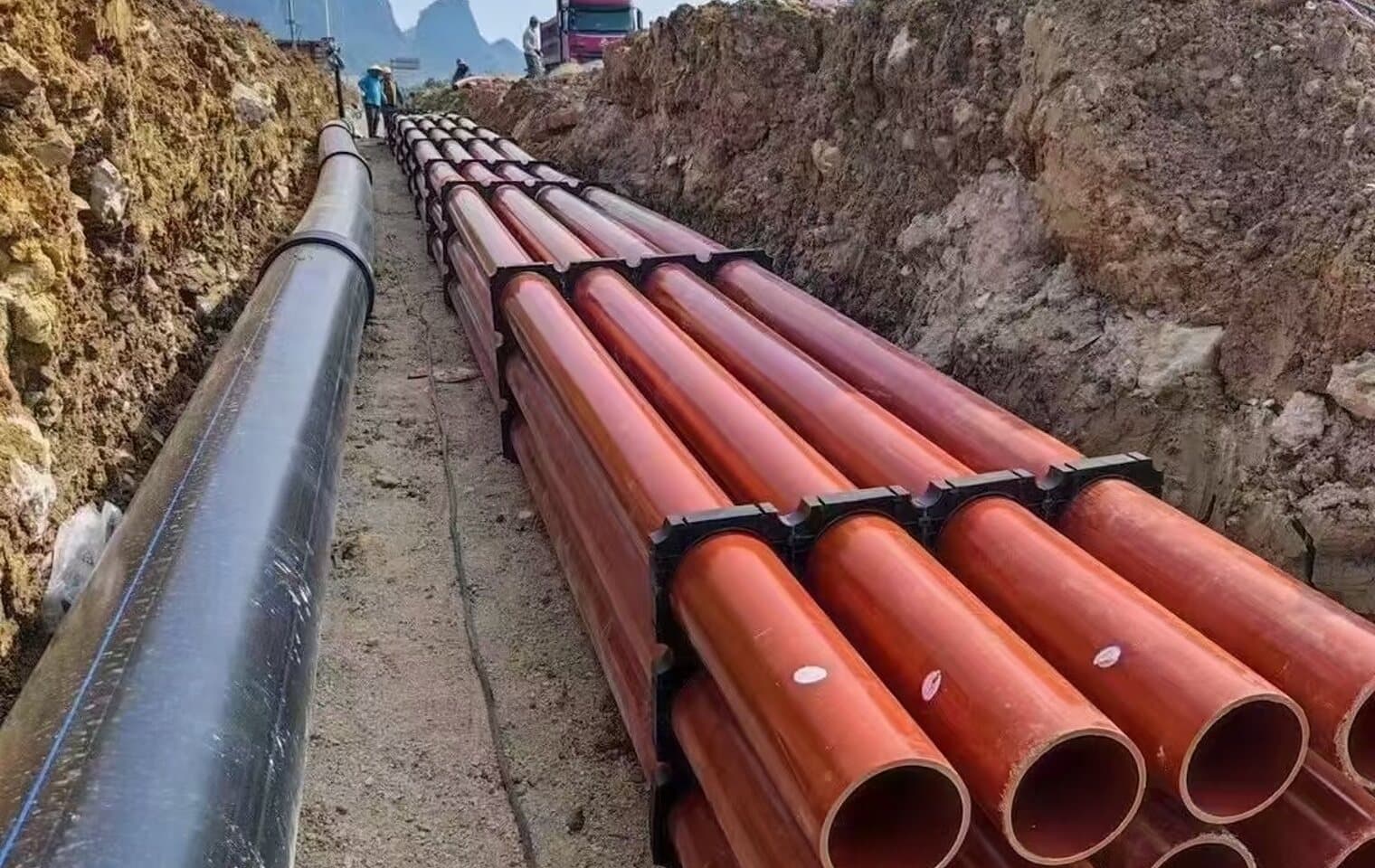
A level, compacted layer under the pipe. Laying on the trench bottom leaves the pipe supported at points instead of along its length.
- 2
Haunching
The wedge between the bedding and the springline, on both sides. This is the area that gets skipped, and it is the area doing the most work — compaction here is what raises E′.
- 3
Sidefill to the crown
Placed and compacted in layers, both sides evenly, or the pipe is pushed sideways out of round before anything drives over it.
- 4
Initial backfill above the crown
300 mm of selected material before any plant runs over the line. This is the layer that protects the pipe from the compaction equipment itself.
How to write the specification
- State the ring stiffness class and the standard together — SN8 to EN 13476 means something; SN8 alone does not say how it was measured.
- State the embedment material and compaction requirement in the same clause. A stiffness class without a compaction spec is half a specification.
- State the deflection limit and when it is measured. 5% long-term is common; a mandrel or CCTV check after backfill is what makes it real.
- Say whether the class is nominal or minimum. Nominal allows a tolerance band; minimum does not.
- For structured wall pipe, ask which construction — double-wall corrugated, spirally wound with a steel band, or solid profile wall. They reach the same SN by different means and handle differently on site.
How we test it, and what to ask for
Ring stiffness is measured on a cut ring at 23 °C to ISO 9969, at 3% deflection, and reported per batch. Ask for the figure rather than the class: a pipe reported at 8.4 kN/m² and one at 12.9 kN/m² are both sold as SN8, and on a marginal design the difference is worth knowing.
