
Ask three suppliers what PE100 means and you will get three answers: a density, a molecular weight, a colour. None is right. PE80 and PE100 are classifications by strength, defined in ISO 12162 and used by ISO 4427, EN 12201 and GB/T 13663 alike. The number is the material's Minimum Required Strength in bar — the hoop stress it is proven to carry for fifty years at 20 °C, rounded down to a standard step: 8.0 MPa for PE80, 10.0 MPa for PE100.
That single number sets the design stress, which with the SDR sets the pressure rating, which with the diameter sets the wall thickness, which sets the weight and therefore the price per metre. Follow the chain and the comparison makes itself.
What MRS actually is
A resin producer tests pipe samples of a compound at several temperatures and hoop stresses until they fail, over as long as a year, and extrapolates the curve to fifty years at 20 °C using the method in ISO 9080. The lower confidence limit of that extrapolation is the material's long-term hydrostatic strength; rounded down to the nearest value in the R10 series it becomes the MRS. A compound with a 50-year strength of 10.4 MPa is PE100. One at 9.8 MPa is PE80, however good it otherwise is, because the next step down is 8.0.
From MRS to pressure rating
σs = MRS ÷ C PN = 20 × σs ÷ (SDR − 1)
σs is the design stress in MPa, C the design coefficient (1.25 minimum for water in ISO 4427), and PN the nominal pressure in bar. For PE80, σs = 6.3 MPa; for PE100, σs = 8.0 MPa.
| SDR | PE80 | PE100 | Change |
|---|---|---|---|
| SDR 26 | PN 5 | PN 6 | +1 class |
| SDR 21 | PN 6 | PN 8 | +1 class |
| SDR 17 | PN 8 | PN 10 | +1 class |
| SDR 13.6 | PN 10 | PN 12.5 | +1 class |
| SDR 11 | PN 12.5 | PN 16 | +1 class |
| SDR 9 | PN 16 | PN 20 | +1 class |
| SDR 7.4 | PN 20 | PN 25 | +1 class |
The same pressure, a different wall
Turn the table around and the buyer's question appears: for a given pressure, what does each grade cost in wall? PN16 at DN110 needs SDR 11 in PE100 and SDR 9 in PE80. From the ISO 4427-2 wall table that is a minimum wall of 10.0 mm against 12.3 mm — 23 % more polyethylene in the PE80 pipe, and a bore 4.6 mm smaller.
| PE100 SDR 11 | PE80 SDR 9 | |
|---|---|---|
| Minimum wall | 10.0 mm | 12.3 mm |
| Maximum wall | 11.1 mm | 13.7 mm |
| Mean inside diameter | ≈ 88.9 mm | ≈ 84.0 mm |
| Mass per metre (mean wall, 0.955 g/cm³) | ≈ 3.15 kg | ≈ 3.78 kg |
| Bore area | 6 210 mm² | 5 540 mm² |
| Flow at the same head loss | 100 % | ≈ 87 % |
Twenty per cent more material per metre and thirteen per cent less flow, for the same pressure. Over a 10 km transmission main that is roughly 6 tonnes of resin and either a larger pipe or a larger pump. This — not any difference in the polymer's quality — is why PE100 became the default for pressure pipe within a decade of its introduction.
Where PE80 is still the right answer
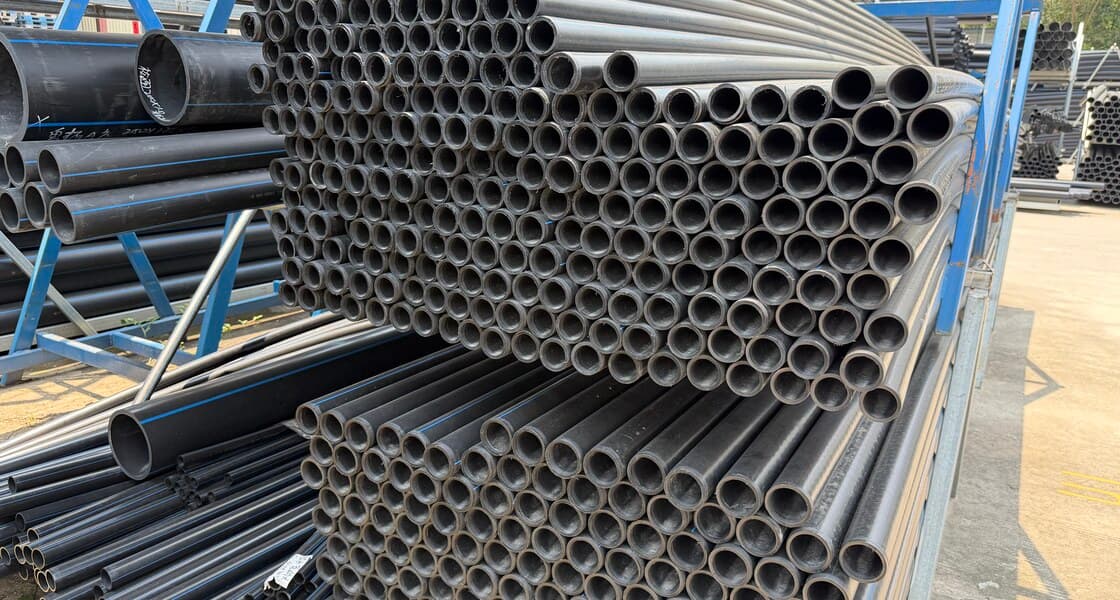
- Low-pressure and gravity service — irrigation laterals, drainage, ducting — where PN6 or PN8 is already more than enough and the thinner-wall advantage of PE100 is not being used.
- Small-bore service pipe, DN20 to DN63, where the wall is at the 2.0–3.0 mm minimum that ISO 4427 sets for jointing regardless of material, so PE100 cannot be thinner anyway.
- Legacy networks specified in PE80 where the utility wants one material grade throughout for stock and fusion-procedure reasons; many gas distribution networks are yellow PE80 for exactly this reason.
- Where flexibility matters more than strength: PE80 has a lower flexural modulus and coils more readily in the same wall, which small-diameter coil users notice.
Fusing PE80 to PE100
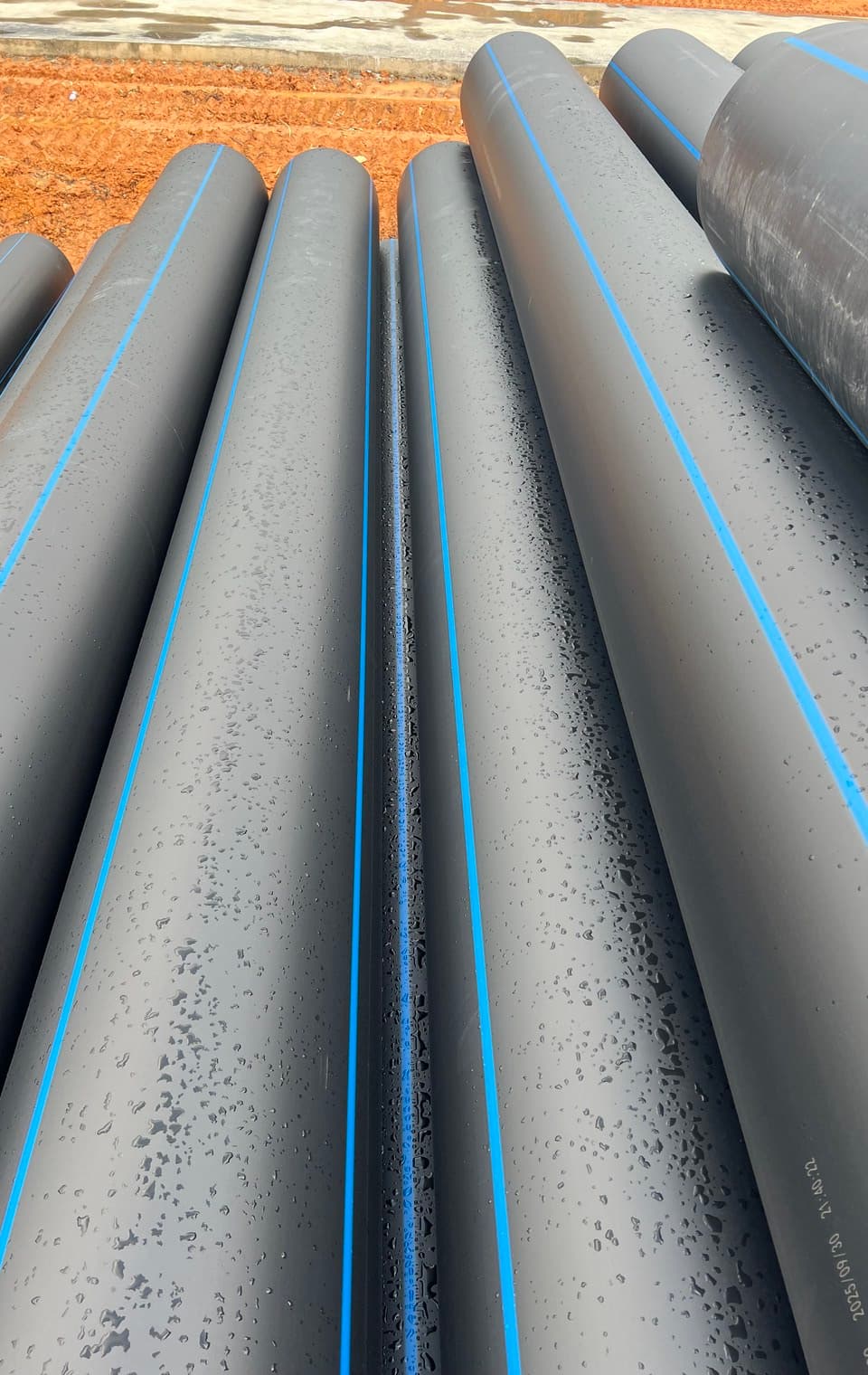
They are compatible. Both grades fuse with the same butt-fusion parameters and the same electrofusion fittings, and a correctly made joint between them is stronger than the PE80 pipe. The practical conditions are the same as for any two pipes: the outside diameters must match, the SDRs should match so that the walls align at the face, and the melt flow rates should be within the same MFR class — which for water-pipe compounds they always are. Tie-ins between an old PE80 main and a new PE100 extension are routine.
How to write it into a specification
- 1
Name the grade and the standard
"PE100 to ISO 4427-2" or "PE100 to EN 12201-2". The grade without the standard leaves the test regime undefined; the standard without the grade leaves the strength undefined.
- 2
Specify pressure by PN, not by SDR alone
SDR 11 means PN16 in PE100 and PN12.5 in PE80. A specification that says only SDR 11 has not said what pressure it wants; state the PN and let the SDR follow from the grade.
- 3
Ask for the compound
The compound producer's grade name and its PE100+ Association listing, if any. A listed compound has been independently tested for strength, slow crack growth and rapid crack propagation; the pipe factory's certificate then covers processing.
- 4
Add PE100-RC where the installation calls for it
Trenchless, rocky ground, sand-free bedding: specify PE100-RC and the notch-test requirement. It costs more per metre and saves the cost of the sand bed or the re-dig.
Written that way, the specification is one line long, unambiguous in any language, and impossible to satisfy with the wrong pipe.
Sources and standards
- ISO 12162: Thermoplastics materials for pipes and fittings — Classification and designation
- ISO 9080: Determination of the long-term hydrostatic strength of thermoplastics materials
- ISO 4427-2: Polyethylene pipes for water supply — Pipes
- PE100+ Association — positive list of PE100 compounds
- Plastics Pipe Institute — Handbook of Polyethylene Pipe, chapter 3 (material properties)