
There is an obvious objection to a factory writing this. Take it as an argument in our favour if you like, but the substance stands on its own: every check below is one a competent buyer can insist on, and any supplier who resists them is telling you something.
Regrind: the one that matters most and shows up last
The most common corner cut in this industry is adding reprocessed material to pressure pipe. It saves real money, it is invisible in a finished pipe, and it does not fail immediately — it fails as slow crack growth, five to ten years in, long after the retention is released.
You cannot see it. You can catch it three ways, and a serious inspection uses all three.
| Check | What it shows | Where it happens |
|---|---|---|
| Melt flow rate (MFR) | Reprocessed material has been through heat before; MFR drifts from the virgin resin's declared value | Laboratory, per batch |
| Oxidation induction time (OIT) | Antioxidant is consumed by every heat history; a low OIT means the material has less life left | Laboratory, per batch |
| Resin lot traceability | Whether the batch can be tied to a specific delivery of virgin resin, with the supplier's own certificate | Documentation |
Dimensions: measure the minimum, not the average
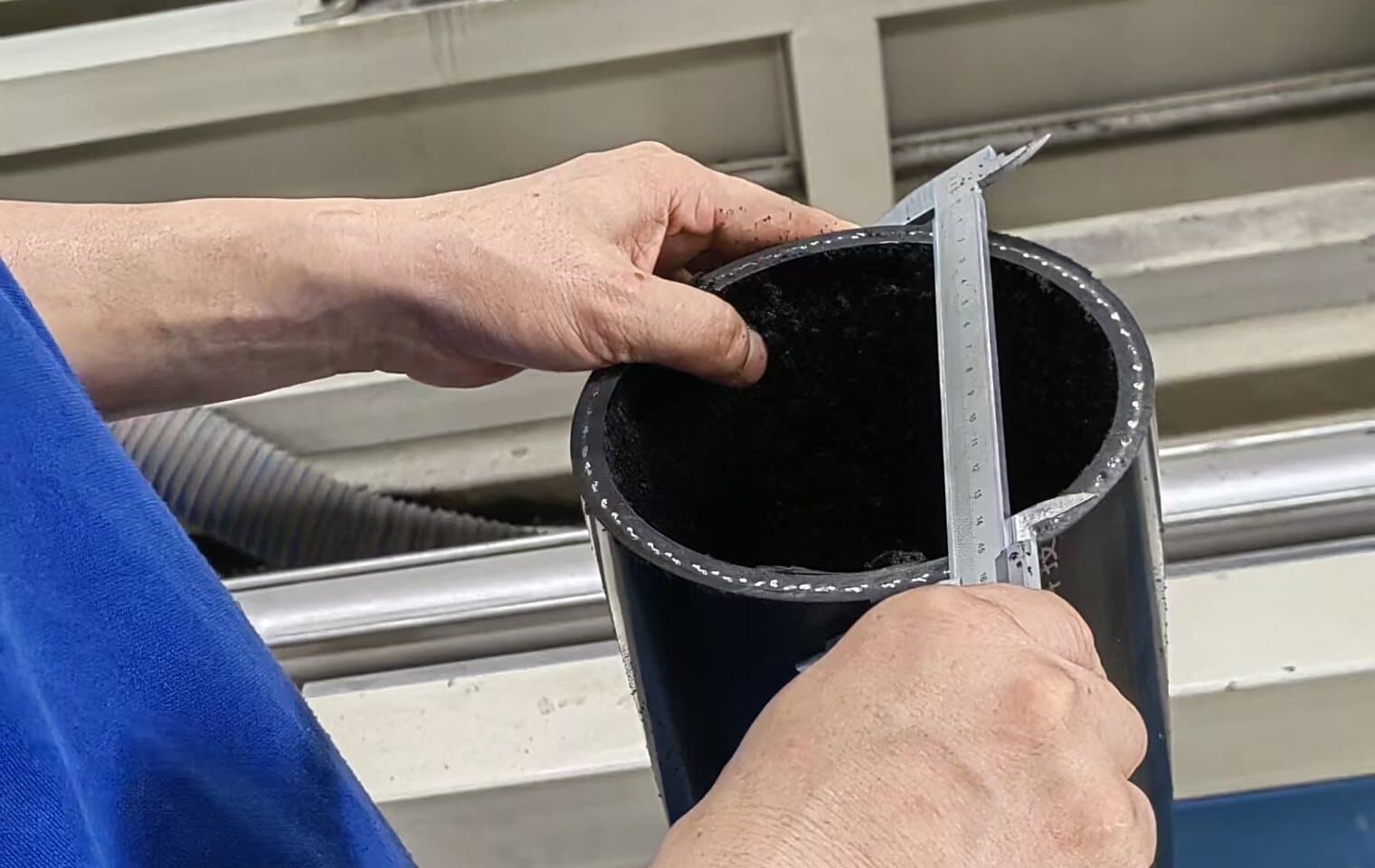
Wall thickness is where SDR is either real or not. The trap is that an average wall can be comfortably in tolerance while one point on the circumference is thin — and the thin point is the one that governs the pressure rating.
- 1
Outside diameter at two axes
Measured at the same cross-section, ninety degrees apart. The difference is the ovality, which matters for jointing as much as for pressure.
- 2
Wall thickness at six points around the circumference
Not two, not four. The minimum of the six is the figure to compare against the standard, and the spread tells you how well centred the die was.
- 3
Length and squareness of the cut
An out-of-square end costs facing time at every butt weld, and on a long run that is hours.
- 4
Ovality on coiled pipe specifically
Coils go oval in storage. Check it on delivery rather than at the trench, where re-rounding equipment may not be to hand.
Hydrostatic testing: which one was actually run
"Hydrostatically tested" on a certificate can mean two very different things, and the gap between them is the difference between a leak check and a proof of design life.
| Test | Duration | What it demonstrates |
|---|---|---|
| Short-term at 20 °C | 100 hours | The batch holds its rated pressure now |
| Long-term at 80 °C | 165 hours at elevated temperature | Accelerated proof of the 50-year design assumption |
| Quick pressure check | Minutes | Nothing about design life — this is a leak test |
Carbon black: content and dispersion are two tests
Black PE pipe is protected from ultraviolet light by carbon black, and both how much there is and how evenly it is spread matter. Content is typically specified at 2 to 2.5 percent. Dispersion is graded under a microscope, and poor dispersion leaves UV-vulnerable areas even when the content figure passes.
What a real certificate contains
- The batch or production run number, and a way to tie it to the pipe you received — the same number should be in the print legend.
- The resin grade and the resin lot number, not just "PE100".
- Results with values, not ticks. "MFR: 0.22 g/10 min" is a result; "MFR: Pass" is a claim.
- The standard each result was measured to, so the numbers can be checked against a requirement.
- The date of test and the signature of whoever ran it.
- Quantity and dimensions matching the packing list and the invoice.
Loading: the damage that happens after the inspection passes
Pipe leaves the factory round and arrives oval more often than anyone admits. Polyethylene creeps under sustained load, and a stack loaded badly and then left in a hot container for six weeks arrives deformed, which shows up at the first butt weld.
- 1
Nesting
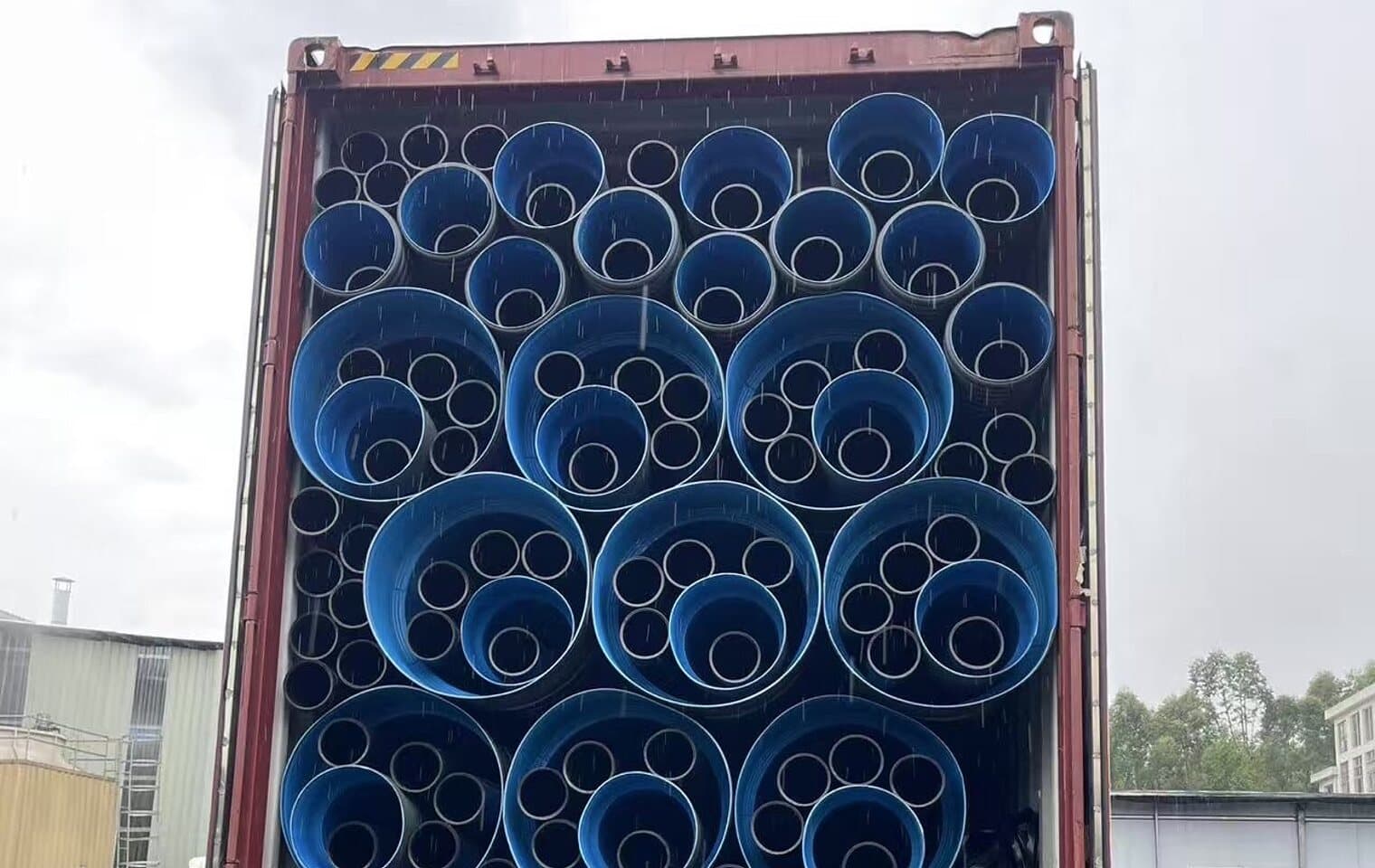
Small diameters inside large ones saves freight and is fine — provided the inner pipe is supported and not resting its weight on the crown of the outer one.
- 2
Stack height and support
The bottom layer carries everything above it for the whole voyage. It should sit on timber bearers, not on the container floor, and the stack height should reflect the SDR.
- 3
Bundling and end caps
Bundles hold shape; end caps keep dirt and vermin out. Both should be visible in the loading photographs.
- 4
Photographs at three stages
Empty container with the number visible, mid-load, and sealed with the seal number readable. Ask for these as a condition of payment rather than as a favour.
When to inspect
| Moment | What you can still do | Cost of a problem |
|---|---|---|
| During production | Change the run | Lowest — the pipe has not been made |
| After production, before loading | Reject and remake | Days, and the factory absorbs it |
| At container loading | Refuse to load | The programme slips |
| On arrival at destination | Argue | You have already paid the freight |
The short version, as questions
- Which resin lot went into my batch, and can I see the resin supplier's certificate for it?
- What were the MFR and OIT results for my batch, as numbers?
- Was the hydrostatic test the 20 °C or the 80 °C one, and for how long?
- What is the minimum wall thickness measured, not the average, and at how many points?
- Are carbon black content and dispersion reported separately?
- Can I inspect before loading rather than at the door?