
Ask a supplier how much pipe fits in a 40-foot container and the honest answer is a question back: what diameter, what SDR, coils or sticks, and will you accept nesting? The evasive answer is “it depends”. Both are true and neither helps you compare two quotes, so this article gives the numbers. They are geometric maxima computed from the container's internal dimensions and the pipe's outside diameter, with the practical allowance stated separately, and the tonnages come from the ISO 4427-2 wall table at mid-tolerance — the same arithmetic we use to plan a load.
The point of knowing them is not to pack the box yourself. It is to see when a quote per metre is hiding a half-empty container, and when a small change — 11.8 m sticks instead of 12 m, one nested size, coils for everything under DN90 — turns two containers into one.
Three boxes and what they hold
| Container | Internal L × W × H (m) | Door opening W × H (m) | Max payload (t) | Longest pipe that loads |
|---|---|---|---|---|
| 20' general purpose | 5.90 × 2.35 × 2.39 | 2.34 × 2.28 | ≈ 28 (often limited to 21–24 by road) | 5.8 m |
| 40' general purpose | 12.03 × 2.35 × 2.39 | 2.34 × 2.28 | ≈ 28 (often limited to 24–26 by road) | 11.8 m |
| 40' high-cube | 12.03 × 2.35 × 2.69 | 2.34 × 2.58 | ≈ 28 (often limited to 24–26 by road) | 11.8 m |
Two things follow from that table. The 40' high-cube is the default for pipe: 30 cm more height is 12 % more volume for a freight rate that is rarely 12 % more. And the standard pipe length of 12 m does not fit a 40' container — the interior is 12.03 m and the corner castings intrude — so pipe for export is cut at 11.8 m, or 5.8 m for a 20' box. Every reputable exporter knows this; a quote that says 12 m and a 40' container in the same line has not been thought through.
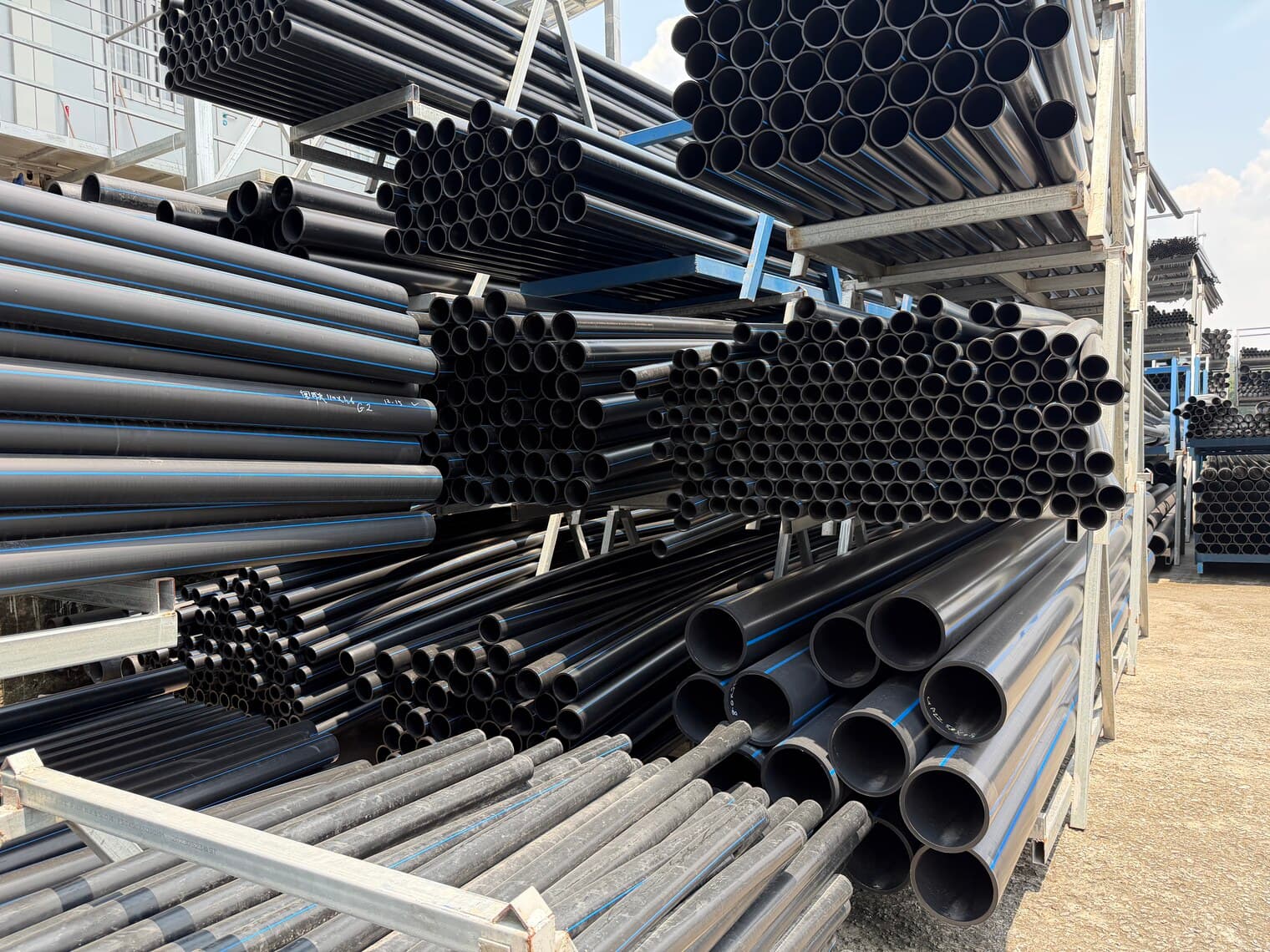
Straight lengths: how many sticks, how many metres, how many tonnes
| DN (mm) | Sticks (across × high) | Metres | Tonnes at SDR 17 | Tonnes at SDR 11 | Limiting factor |
|---|---|---|---|---|---|
| 63 | 37 × 42 = 1,554 | 18,300 | 13.1 | 19.2 | Volume (coil instead — see below) |
| 90 | 26 × 29 = 754 | 8,900 | 12.9 | 18.9 | Volume |
| 110 | 21 × 24 = 504 | 5,950 | 12.9 | 18.7 | Volume |
| 160 | 14 × 16 = 224 | 2,640 | 12.0 | 17.7 | Volume |
| 200 | 11 × 13 = 143 | 1,690 | 11.9 | 17.6 | Volume |
| 250 | 9 × 10 = 90 | 1,060 | 11.7 | 17.2 | Volume |
| 315 | 7 × 8 = 56 | 660 | 11.5 | 17.0 | Volume |
| 400 | 5 × 6 = 30 | 354 | 9.9 | 14.7 | Volume, poor fit |
| 500 | 4 × 5 = 20 | 236 | 10.4 | 15.3 | Volume, poor fit |
| 630 | 3 × 4 = 12 | 142 | 9.9 | 14.6 | Volume — nest or ship break-bulk |
Read down the SDR 17 column and one thing stands out: not a single row reaches even 14 t. Polyethylene pipe is light, and a 40' box of thin-wall pipe is two-thirds air. That is why the price per metre delivered depends so heavily on packing: freight is per container, and a container of DN315 SDR 17 carries 660 m to spread it over. Only at small diameters and heavy walls — DN63 to DN110 in SDR 11 and thicker — does a full box approach the road limits of some destinations, and those are exactly the sizes that should be coiled anyway.
Nesting: pipe inside pipe
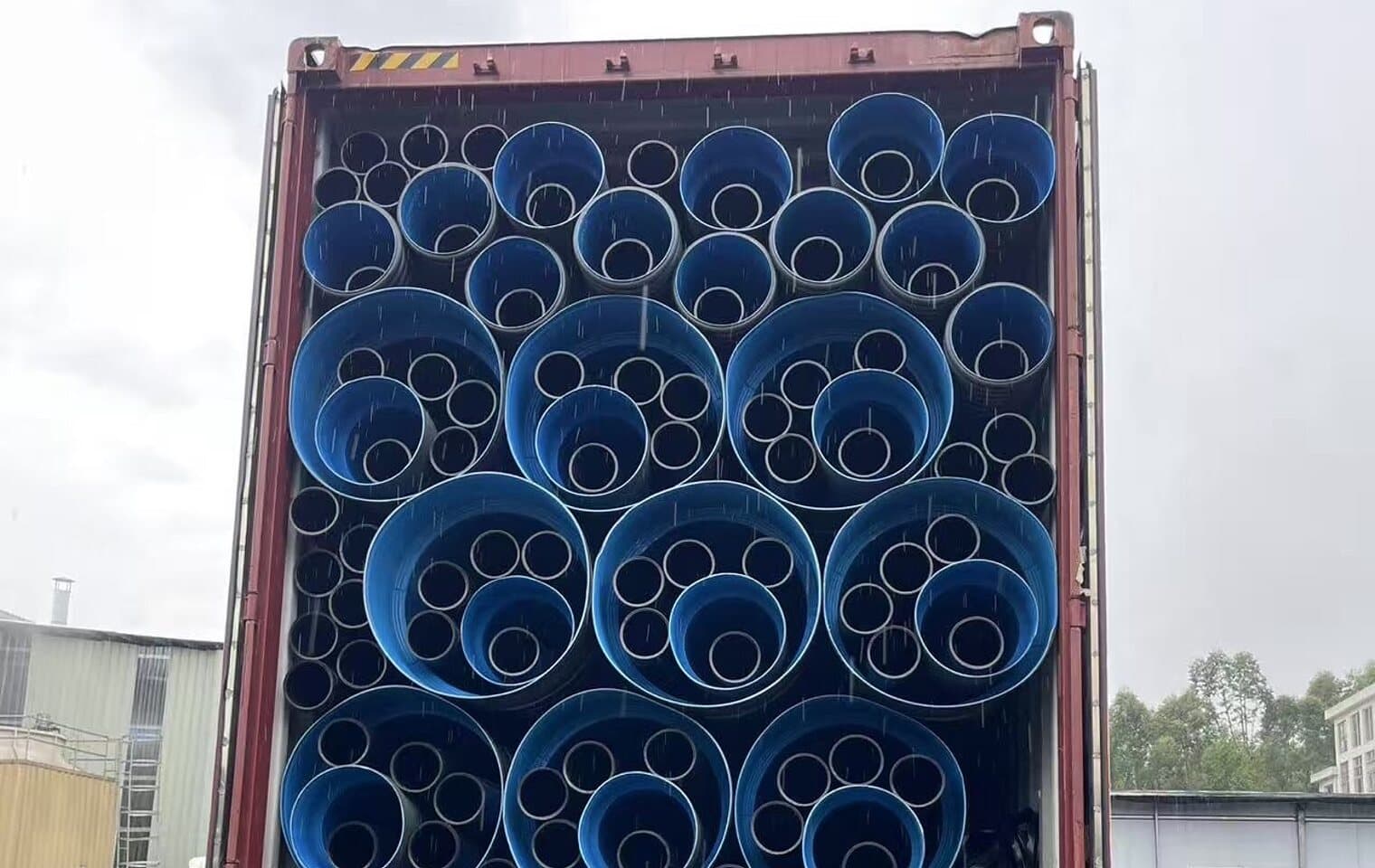
Nesting — sliding a smaller pipe inside a larger one — is how a mixed-diameter order fills a container instead of two. The rule is simple: the inner pipe's outside diameter must clear the outer pipe's inside diameter by enough to slide in and out without scoring, which in practice means 10 mm or more, and the inner pipe must be capped or spaced at the ends so it cannot rattle against the outer wall in a rolling ship for five weeks. Thin-wall pipe nests better because it has a bigger bore for the same DN.
| Outer pipe DN | Its bore at SDR 17 (mm) | Largest pipe that nests | Radial clearance (mm) | Note |
|---|---|---|---|---|
| 315 | 276 | DN250 | 26 | Comfortable; DN250 SDR 11 fits too |
| 250 | 219 | DN200 | 19 | Fine |
| 200 | 175 | DN160 | 15 | Fine; cap both ends |
| 160 | 140 | DN110 | 30 | Comfortable; DN125 (15 mm) also works |
| 110 | 96 | DN75 | 21 | DN90 would leave 6 mm — too tight, it scores |
| 75 | 65 | DN50 | 15 | Below this, coil instead of nest |
Coils: small bore, big savings
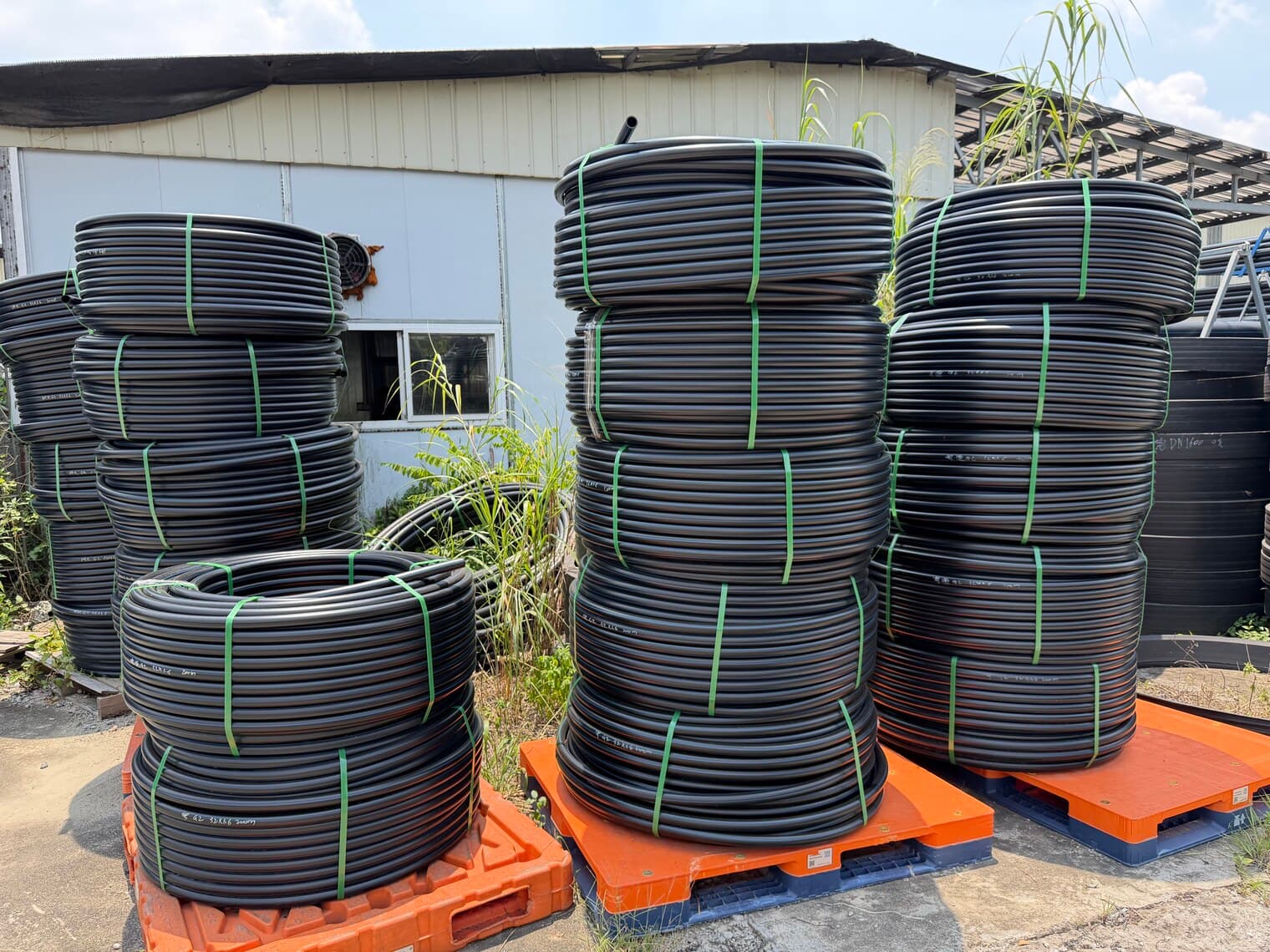
Pipe up to DN90 in SDR 11 and DN110 in thinner walls is flexible enough to coil, and coiling changes the loading arithmetic entirely: a DN32 coil of 100 m occupies a disc about a metre across and 30 cm deep, and coils stack flat on pallets or stand on edge in racks. Standard coil lengths are 50 m, 100 m and 200 m, with 300 m and 500 m drums for DN20–DN40 on request. A coiled order also has far fewer joints on site — one every hundred metres instead of every twelve — which for a farm or an irrigation scheme is more valuable than the freight saving.
Sticks, coils and fittings in the same box
Most project orders are a mix: a few hundred metres of DN315 main, some DN160 branches, coils of DN63 for services, and a pallet of fittings. The container is loaded in a fixed order so that nothing heavy rests on anything that cannot take it and the fittings are reachable at the door.
- 1
Floor bearers, then the largest sticks
Timber bearers across the floor keep the bottom row off the steel and give the straps something to bite. The biggest diameter goes in first, along the length, in rows.
- 2
Nest as each row goes in
Inner pipes are pushed in before the next row is stacked, with end caps or spacers fitted. It is impossible to nest after the row above is on.
- 3
Strap every two or three rows
Polyester lashing across the load and to the container's lashing rings, tensioned but not crushing. Thin-wall large-bore pipe ovalises under an over-tight strap.
- 4
Fill the voids with coils
Small coils lie in the gaps above the top row and against the walls, in bags to keep them clean.
- 5
Fittings and small coils on pallets at the door
Fittings travel in cartons on pallets, strapped, with a packing list on each pallet. They come out first at the site and are counted first.
- 6
Dunnage, photographs, seal
Airbags or timber brace the load against the door. The load is photographed from the door with the container number in frame, the seal is fitted, and the seal number goes on the bill of lading.
Paperwork that travels with the pipe
| Document | Must show | Who relies on it |
|---|---|---|
| Packing list | Per line: DN, SDR, PN, colour/stripe, length or coil metres, pieces, metres, net and gross kg; nested items listed separately; container and seal numbers | Customs, the unloading crew, your stock system |
| Mill test certificate (per batch) | Batch numbers matching the pipe print line; dimensions, MFR, OIT, carbon black, hydrostatic tests to ISO 4427-2 | Your engineer, the client's inspector |
| Compound certificate | Resin maker, grade, MRS classification; PE100+ listing if claimed | Your engineer |
| Certificate of origin | Exporter, HS code (3917.21 for PE tubes), country of origin — determines duty | Customs broker |
| Commercial invoice | Incoterm and named place; currency; matches packing list quantities exactly | Customs, your bank |
| Bill of lading | Container and seal numbers matching the packing list; shipper, consignee, notify party | Carrier release at destination |
| Loading photographs | Interior before door closure, container number and seal in frame | Insurance claim, if it comes to that |
Landed cost: turning metres into money
landed cost per metre = (FOB price + ocean freight + insurance + duty + port and inland charges) ÷ metres actually loaded
FOB is the price at the loading port under Incoterms 2020; freight and insurance are per container; duty is a percentage of the CIF value at the HS code; metres actually loaded is the number on the packing list, not the geometric maximum.
That denominator is the whole argument of this article. Two quotes at the same price per tonne can differ by 20 % per metre landed if one supplier ships 11.8 m sticks nested and coiled and the other ships 12 m on a flat-rack. Ask every supplier for the metres per container they will actually load for your mix, and put that number in the comparison next to the price. It is the one figure the brochure never carries.