
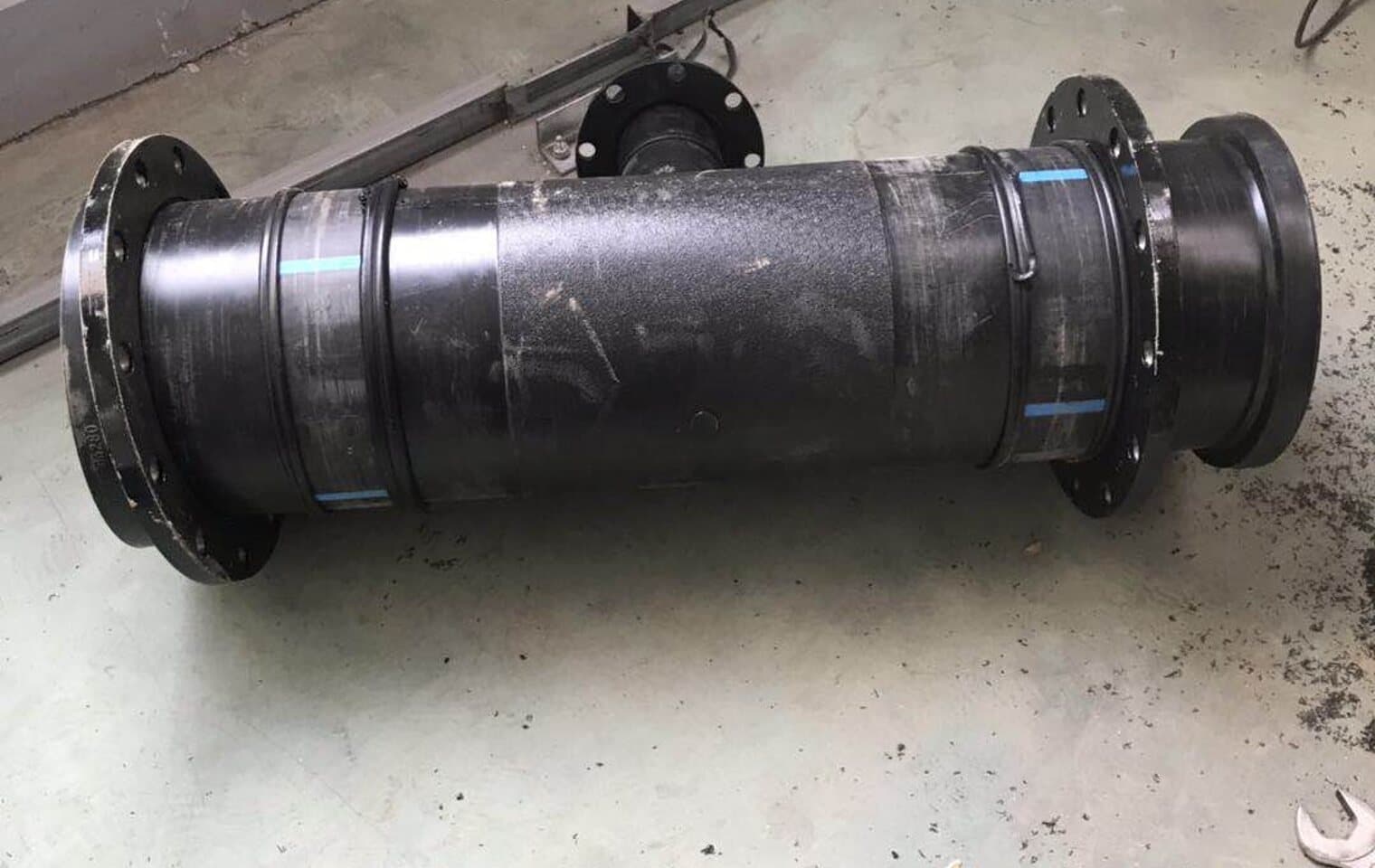
Heavy-wall PE100 pipe with bolted flange faces, stacked ready for slurry duty

HDPE Pipe

Mining & Slurry Pipe

Thick-wall abrasion-resistant pipe for tailings, dewatering and process lines on mine sites.

A flanged PE spool on the workshop floor, both ends drilled for a mine water line

Slurry duty punishes pipe. We build for it with heavy-wall PE100 in SDR 7 through SDR 17, where the combination of wall thickness and HDPE's low friction and elastic recovery gives service life that steel and rubber-lined alternatives struggle to match at the same installed cost.

Lines are supplied with fabricated flanged spools, stub ends and backing rings so sections can be rotated to even out wear, plus long-radius bends that reduce erosion at direction changes. We have shipped tailings and dewatering lines to mine sites across South America, Africa, Australia and Central Asia.

Key features

  • PE100 heavy wall, SDR 7 / SDR 9 / SDR 11 / SDR 13.6 / SDR 17
  • DN90–DN1200, in 6 m, 11.8 m or fabricated spool lengths
  • Flanged spools with stub ends and galvanised or ductile backing rings
  • Long-radius mitred bends to cut erosion at direction changes
  • Rotatable sections to extend line life on abrasive duty

Specifications

Mining & Slurry Pipe technical specifications
MaterialPE100, high-molecular-weight grades
Diameter rangeDN90 – DN1200
SDRSDR 7 – SDR 17 (PN10 – PN25)
ConnectionsButt fusion, flanged spools, Victaulic-style couplings
Typical dutyTailings, dewatering, process water, reagent lines

Frequently asked questions

How does HDPE compare with steel on abrasive slurry?
On installed cost over life, HDPE usually wins for low-to-medium pressure slurry. It does not corrode, its smooth bore resists build-up, and it flexes with ground movement instead of cracking. Steel still wins where operating pressure exceeds what a practical wall thickness can carry, or where temperature is high.
Can worn sections be rotated?
Yes, and they should be. Wear concentrates in the invert, so rotating a flanged section 120° twice over its life can roughly triple the metres carried before replacement. That is why we supply slurry lines as flanged spools rather than one continuous fused string.
What wall thickness do tailings lines need?
SDR 11 to SDR 7 covers most tailings and dewatering duties, driven by operating pressure plus a wear allowance rather than pressure alone. Send the slurry density, particle size, velocity and design pressure and we will propose an SDR with the sacrificial wall allowance stated separately.

Need a quote or a spec check?

Send us your drawing, tender document or bill of quantities. Our engineers reply within 12 working hours with pricing, lead time and a container loading plan.